Tuesday, May 31, 2022

Seth Brundle is, um, the odd man out

 THE FLY (1986)
Reviewed by Jerry Saravia

"The Fly" is an upsetting, riveting, emotional disturbance in the horror genre. It is director David Cronenberg's remake of the 1958 classic that contains that famous line screamed by a webbed human face on a fly's body, "Help me!" Somebody better help Seth Brundle, a brilliant scientist who has invented teleportation pods that can transfer inanimate objects with ease. What about animate, living breathing beings? Hmmm.

The ever enthusiastic Seth (Jeff Goldblum, perfect casting with those bugged-out bug eyes) eventually finds a clue in his voice-activated computer system which controls the teleportation pods - maybe it is probable to transfer flesh without killing the living thing (a baboon is the initial try and it proves disastrous). Geena Davis is Veronica, the journalist working for Particle magazine, a science publication like Omni, who witnesses this transformative event with the use of Betamax video cameras (my, how far we have come since). She also falls in love with Seth who encounters one too many physical changes in his body. He performs amazing gymnastics, starts eating too much sugar with his cappuccino, becomes aggressive (especially when having sex) and, well, we know what has happened - when he teleported, a fly flew in the pod and became fused with Seth. 

Think of "The Fly" as a horrific sight for the eyes and ears though, in hindsight, not nearly as gory as I remembered back in 1986 (that sickeningly gooey theater experience was my first encounter with Cronenberg). Yes, there are yucky, slimy, fluid-looking effects and the whole notion of flesh and its deformities when changing into a fly is where Cronenberg finds he's at home (though I guess we can be thankful that Cronenberg does not dwell on such fleshy details up close). One scene in a bar where Seth shows his physical strength in arm wrestling will leave you wincing and looking away. When he is slowly becoming a fly, you'll notice the yellow fluids staining his clothes and then, eek, his teeth, fingernails and various body parts start to come off. This is hardly an easy film to, um, digest after it is over.

The reason "The Fly" is not geeky, exploitative horror is because Jeff Goldblum and Geena Davis bring so much tenderness to their roles and as a magnetic romantic couple (which they were at that time) - they really do click and you hope that this gradual fly transformation won't disrupt it. The love between them is almost inseparable despite Seth's growing deterioration - she is willing to stand by him and love him regardless of what he looks like. When Seth (who can climb walls and ceilings like Spider-Man) tells her that he might hurt her if she sticks around, it is genuinely moving and heartfelt. Even in pounds of makeup and latex, Jeff Goldblum still shines with his rapier-like delivery of dialogue (this was also the first time I started to notice Goldblum's dexterous use of his hands to denote the character.) 

Despite his heroic turn towards the horrifying and deeply emotional climax, John Getz plays a despicably arrogant, obnoxious ex-boyfriend of Veronica's whose occasionally cringe-inducing lines of dialogue (asking for sexual favors) wouldn't stand half a chance in today's world. He's practically unsympathetic yet Getz, in a progressively modulated performance, manages to still show he loves Veronica. Both men love her, yet there is still the odd fly out. 

Monday, May 23, 2022

Johnny Smith sees the past and the future

 THE DEAD ZONE (1983)
Reviewed by Jerry Saravia
Originally seen in 1983

'As he was a bachelor, and in nobody's debt, nobody troubled their head about him anymore'.

This is a line from Washington Irving's short story "The Legend of Sleepy Hollow" and we realize the psychic Johnny Smith may have been forgotten while in a coma. Yet now with his newly discovered psychic powers after waking from a coma, everyone wants a piece of him. David Cronenberg's "The Dead Zone" is a disquieting, extremely effective and tightly structured thriller, among the finest adaptations of Stephen King's novels. It is one of the few remarkable horror pictures with a science-fiction bent that draws out the humanity more than the special effects to work. And boy, does the movie work overtime on your nerves.

Set in the fictional Castle Rock, New Hampshire, Johnny Smith (Christopher Walken) is a teacher who has an affinity for Washington Irving and Edgar Allan Poe. He is dating a fellow teacher, Sarah (Brooke Adams), who is completely head over heels in love with him yet their love remains unconsummated. Rather than spend the night with Sarah, he travels home during a thunderstorm and gets into an accident with an 18-wheeler truck. Five year later, Johnny wakes up from a coma and discovers he has psychic powers. First, he sees a young girl in danger of dying in a fire just by touching the hand of a nurse, the girl's mother. Later he picks up clues to a murder by touching the hand of the murdered victim! This guy starts getting tons of mail at his address with possible requests to retain his second sight services, yet his headaches gets worse and he walks with a limp. To top it all off, Johnny's former love Sarah is now married with kids. And to make matters worse, a driven political candidate named Greg Stillson (Martin Sheen) is in town and is ready for a future Presidency. When Johnny touches Greg's hand, let's say there could be a potential nuclear annihilation in the future. Johnny now discovers he can see the future.


Most of "The Dead Zone" is chilling in its atmosphere, from its wintry locations (filmed in Canada), to the cool colors of the characters' wardrobes (Sarah wears a blue dress in her first meeting with Johnny post-accident; Anthony Zerbe, playing a millionaire, wears a blue robe after the demise of a hockey team that his son thankfully did not participate in, thanks to Johnny's intervention); to the frightful surroundings of an icy tunnel; to Greg Stillson's senatorial campaigning with a Norman Rockwell logo combining blue and red colors that looks offputting, and so much more. Director David Cronenberg brings this grim tale alive with subtle art direction that feels just right and all the right tension notes are played - the whole movie really gets under your skin. One scene must be discussed here: the location of the Castle Rock Killer in a small house. The home looks inviting enough yet when Johnny enters along with the Sheriff (Tom Skerritt), something again feels off and it is not just the killer's overprotective mother (a crushing cameo by Colleen Dewhurst). The room look infantilized (wallpaper of cowboys and Indians, a paperback for kids called "Apache Kid") yet the normal-looking bathroom where a self-mutilation occurs keeps us off track yet again. The setup, the terse music score Michael Kamen, and the camera compositions of not knowing what lurks around the corner builds the frightful suspense in such intensifying ways that most crime TV shows of late or crime movies couldn't possibly match.

Christopher Walken gives a sympathetic, fully layered performance of a man who cannot fathom why he has these special powers or why he had to suffer and lose out on the life he wanted. When he discovers the truth about Greg Stillson and asks his doctor (deftly played by Herbert Lom) if he would've killed Hitler knowing what he was about to do, it chills us to the bone because we understand and want to nurture Johnny in whatever decision he wants to make. Same with Sarah, wonderfully and poignantly played by Brooke Adams, who so desperately wanted a life with Johnny yet she can't really let him go. Life takes its own toll on people and we carry on through whichever path it leads us. Johnny, fortunately or not, has the power to change that and even he doesn't know where it might lead. 

Thursday, May 19, 2022

Fighting to stay alive during the Depression

 HARD TIMES (1975)
Reviewed by Jerry Saravia

Charles Bronson might have been one of the tough guy movie stars of the 70's but he acknowledged something deeper, more fundamentally human in his early roles. When Bronson fights bare knuckled, you sense that he doesn't wish to hurt his opponents. He may bruise them and knock them out but he shows compassion towards his opponent - a sense of reluctance despite wanting to win. Bronson in the 70's is wildly different from the "Death Wish" sequels and Menahem Golan pictures he made in the 1980's. In the role of a drifter in the Depression-era drama, "Hard Times," he is perfectly cast because it seemed close to the real Charles Bronson.

The year is 1933 and Chaney (Bronson) is freight-hopping from town to town trying to make a buck and move North. Chaney is something of a mystery and a no-frills type of guy - he is not out to hurt people and he keeps to himself (so was the real Bronson). He arrives in Louisiana and his interest is piqued when a bunch of men enter a warehouse and hold illegal bareknuckle fights. One of the promoters is Spencer "Speed" Weed (James Coburn, a truly energetic, colorful performance), a fairly unscrupulous opportunist who just wants enough money to gamble. Chaney tries to convince Speed that he can fight despite being older than most of the competition and I guess I could say, "Let the games begin!" but it is not that kind of movie. Speed takes Chaney to New Orleans where he beats two opponents (one of them is a bald smiling musclebound fighter memorably played by Robert Tessier) and yet none of this works out too smoothly for Speed. Speed has to deal with mobsters (one of them played by Bruce Glover, who I wished there was more of) and a wealthy seafood tycoon (Michael McGuire, a very cunning, sharply powerful presence) who wants $3,000 dollars to cover for his other opponent, a formidable fighter from Chicago whom the tycoon hopes will beat Chaney.

So there are the loan sharks and the mob circulating their efforts around Speed. Meanwhile the reluctant Chaney lives in one of the more impoverished sections of New Orleans and strikes a brief love affair with Lucy (Jill Ireland) who is not to sure of this cautious man with a heart of gold. Lucy is married but her husband is away and Chaney feels a kinship though it is not much of a romance. Curiously, many of Ireland's scenes were reportedly cut and that is a shame because Bronson and Ireland spark the screen with their limited conversations. He shows his empathy towards her, willing to help her domestic situation.

"Hard Times" is a tightly woven, sharply written and muscularly directed effort - Walter Hill's directorial debut. The pacing is swift, the fights are realistic and exciting, and the period setting and clothes are top of the line. In the midst of all this, Charles Bronson is the enigmatic and disinclined hero who comes into town like some sort of savior, an angel with a certain toughness who (SPOILER ALERT) saves Speed's butt and moves on. Chaney even gives away some of his winnings to Speed and Poe (Strother Martin), a former opium-addict and medical student who treats Chaney's cuts. Chaney is a mysterious man we should champion more often.

Wednesday, May 18, 2022

Doesn't take my breath away

 TOP GUN (1986)
A Lack of Appreciation by Jerry Saravia

Among some of the most nauseatingly sleep-inducing 1980's flicks that I can think of, "Top Gun" might indeed take the cake and top honors. It is the one that is on par with the very popular "Dirty Dancing" as bland, superficial cinema with nothing to chew on, or even lick your lips over. There is no residue, only an empty void where you struggle to remember anything of value in a sea of Dolby-ized noise.

"Top Gun" is remembered as the most jingoistic Navy recruitment film of the 1980's, reminding one of the propaganda war flicks of the 1940's except with better aerial footage. I say remembered because it is a film that I had no actual recollection of seeing. I did not see it in a theater but a friend of mine back then told me that we watched it on videocassette. I was flabbergasted by his comment at the time - we saw this movie that I had no interest in seeing? I had no memory of this and, for the record, I remember seeing David Lynch's "Dune" in theaters only because of Sting's electrifying performance and the fact that we pelted the screen with sticky, buttery popcorn (oh, what fun to be such callow teenagers). Then it hit me, "Top Gun" was just a bore, a movie about nothing and usually movies about nothing are forgotten and evaporate from the mind after one finishes watching them. Yet I saw "Dirty Dancing" on video and I must say, that movie at least had a killer oldies soundtrack (which I still have on cassette) and the famous moment where Jennifer Grey...well, you know it. Yet I hated that movie passionately because it was a stupid, unbelievable love story about a dance instructor prick played by the late Patrick Swayze who teaches Grey how to dance. At least "Dirty Dancing" had the courage of its bad movie convictions, if that makes any sense. 

I don't hate "Top Gun" - I just find it unmemorable and sleep-inducing. I have tried to watch it more than once back in the 1980's and it did nothing for me. The aerial footage of defense planes racing and swooshing through the air in formation is well-done and perfectly executed...but so what? Tom Cruise is Lt. Maverick, a wild, reckless pilot who "feels the need for speed!" Oh, brother, someone shoot me. Val Kilmer is another crazy, unpredictable pilot named the "Iceman" and they both vow to one-up and challenge each other to see who really feels the need for faster speed on board an F-14. Or something like that. I am aware that a sexual relationship occurs between Maverick and his flight instructor (Kelly McGillis) who appears to be too intelligent and wise to put up with a hothead like Maverick. Ah, and who can forget the Berlin song "Take My Breath Away," which is not a bad song but it deserved to be in a better movie. You can keep the Kenny Loggins song "Danger Zone." 

Other than that, I have nothing else to say about "Top Gun." In terms of Tom Cruise's bad movie meter, "Cocktail" is a far more thunderous assault on the senses of good taste but that is like comparing one rotten apple versus another rotten apple with no core. Apparently people have been waiting 35 years for a sequel to "Top Gun." I don't recall anyone back in 1986 clamoring for another chapter in the nonsensical adventures of Maverick yet, here we are and a new movie called "Top Gun: Maverick" is in the wings and about to be released in theaters after several delays due to COVID. Quentin Tarantino's take on an alleged gay subtext in "Top Gun" as relayed in one scene in the otherwise forgettable "Sleep With Me" is far more invigorating than any one frame of "Top Gun." "Top Gun" just doesn't take my breath away.  

Tuesday, May 17, 2022

Borrowing a work of art for the good of humanity

 THE DUKE (2020)
Reviewed by Jerry Saravia

"The Duke" is the kind of low-key and tasty British tale based on a true story that will please the most jaded cinephile. It is a simple tale that we could use more of in this day and age and, though it may not receive the biggest audience, it is unlikely that anyone won't see how its piquant charm is wore on its sleeve.

Jim Broadbent is a 60-year-old taxi driver named Kempton Bunton who tries to right the wrongs of society - it is his mission in life. One of his campaigns in the city of Newcastle where he resides is for the BBC to stop charging licence fees for televisions, especially the pensioners in his age group when television should be free to everyone (something I never heard of before, all factually based and actually resolved in 2000). Bunton refuses to pay the licence fees and is repeatedly jailed. Bunton himself is married to the dour Dorothy Bunton (Helen Mirren, almost unrecognizable) and they have two sons, one of them is in construction, Kenny (Jack Bandeira), who gets into trouble with the law. There is also a teenaged son named Jacky (Fionn Whitehead) who does his best to defend his father's actions. There was a daughter at one time who died far too soon and much of that grief results in Kempton writing unproduced plays. All Dorothy can do is appear glum and nitpick anything Kempton does.

An inspiration occurs to Kempton when he allegedly steals a priceless Goya painting from the National Gallery of London. His reasons for stealing the painting are mostly justified by insisting he is "borrowing" the painting so as to agree to a ransom in exchange for the BBC to remove the mandated TV licence fees! Yeah, that does not go over well. And when Dorothy discovers the truth behind the painting that is hidden behind the wardrobe, she is more shocked than elated by this man's ballsy moves, no matter the justification.

"The Duke" starts off as extremely low-key and it can be a bit of an endurance test, at first. However, the film finds it footing with the eventual and unusual caper and with Jim Broadbent's winning performance that slowly gains our sympathy. I would say the film becomes perky when he starts complaining about licence fees because we sense he's a man of principle. Quite frankly, despite being based on a true story, I might have included less time with the sons (though one of them figures heavily in the film's denouement). It was hard to muster much interest in them (and the elder son's girlfriend who decides to live with the Buntons who first discovers the stolen painting), as opposed to Jim Broadbent and Helen Mirren who could make a movie riveting just from drinking milkshakes (they make a great older couple and show much vitality and nuance).

Regrettably director Roger Michell's last film (he died before it was released), "The Duke" does win you over and inspires one to do good for humanity. Kempton Bunton wants to make the world a better place (and he despises racial bigotry, especially in the work force when it comes to a Pakistani employee) and he no doubt inspires the courtroom during his trial. He will do anything he can to help anyone and is, spoiler alert, found not guilty due to his unforced compassion for others. Helen Mirren's Dorothy slowly realizes his sensibilities are apropos. "The Duke" has a universal charm that we could definitely use more of. I cheered. 

Sunday, May 15, 2022

Natural Born Killers of musicals

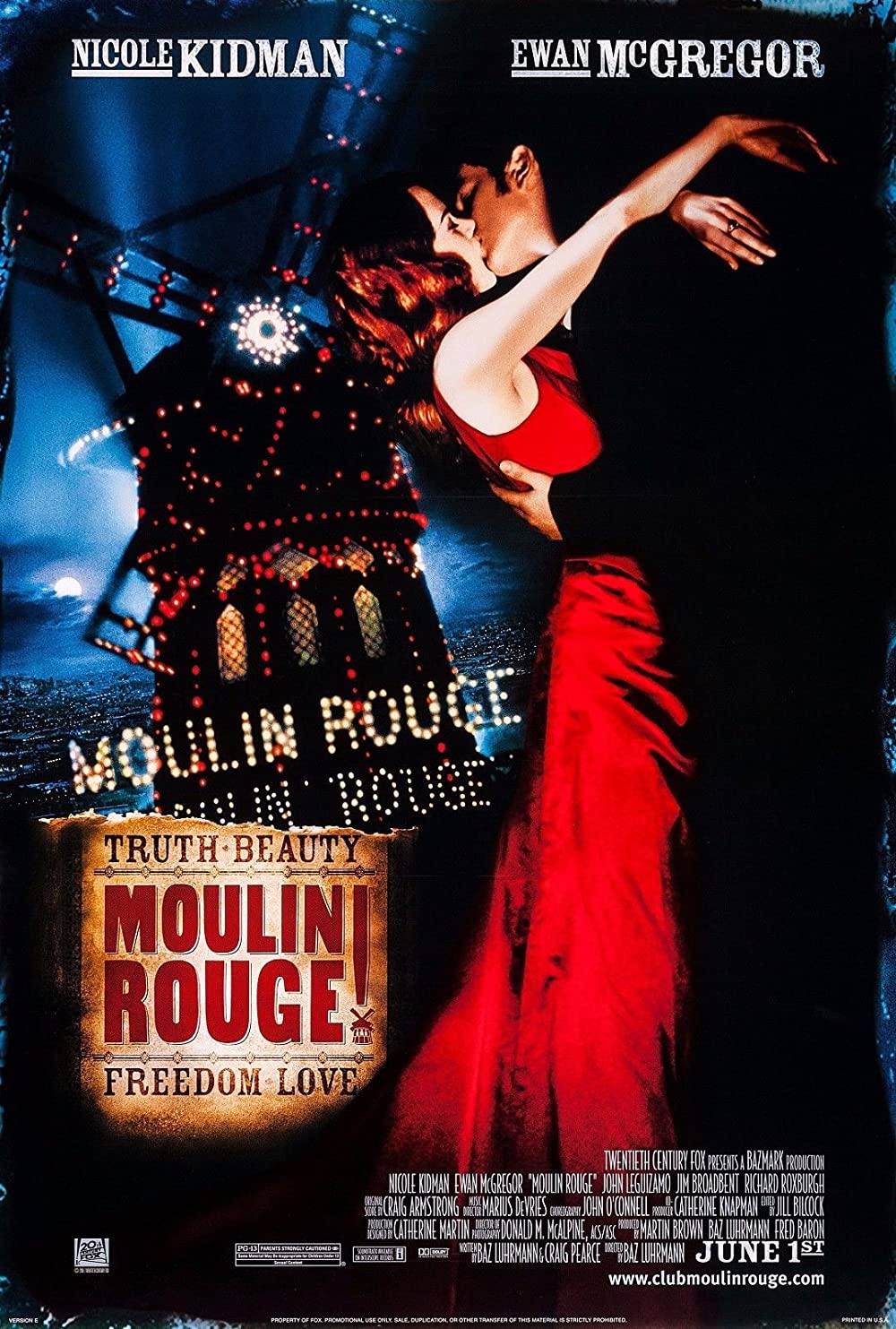
 MOULIN ROUGE
Reviewed by Jerry Saravia
Originally viewed on July 3rd, 2001

The beauty, flash, energy and movement of "Moulin Rouge" is astounding. It is not just a film, it is a kinetic, visual barrage of richly colored images and upbeat music that thrill and dazzle the mind and enrich the heart. It is also the most tantalizing love story of the year by far.

Ewan McGregor is Christian, a young writer who holds certain ideals in mind, namely the pursuit of "truth, beauty, and love." As soon as he arrives in Paris, he is thrown into the world of the Moulin Rouge which holds all his ideals and more. The Moulin Rouge shown in this film is less the actual nightclub of 1900 and more like a sinful, panoramic display of decadence gone wild. It is so wild and hyperkinetic that director Baz Luhrmann makes us feel we are inside a demented madhouse where anything can happen - we are at the Moulin Rouge firsthand enjoying the party of our lives.

Before embarking at the Moulin Rouge, Christian is introduced to the dwarf artist Toulouse-Lautrec (John Leguizamo) who lives above Christian's tenement. Lautrec comes crashing through Christian's roof one day and, after some initial patter, discovers he can use Christian's creative mindset for a show called "Spectacular Spectacular." The show could prove fruitful for the Moulin Rouge and for introducing the star dancer Satine (Nicole Kidman) - as well as provide income for Lautrec and his merry band of artists and dancers. In order to get backing, they must persuade the snooty Duke of Worcester (Richard Roxburgh) to finance it. In one startlingly funny scene, the group improvise the entire show to the Duke - a sort of rambunctious version of a Hollywood pitch meeting. The Duke is overwhelmed and yet sold to the idea. There is only one hitch - the Duke must also have Satine as his bed mate and possible wife.

The character of Satine is the one that shines the most in "Moulin Rouge." She is a prostitute and flashy dancer but underneath her exterior lies a deathly ill woman whose heart sings whenever she sees Christian. Christian adores Satine and is inspired by her. Satine is pleased by the attention and loves Christian but she is also aware of her duties, to please the sneering Duke who is after all financing the play. One character in the film even sings the famous phrase, "And the show must go on."

"Moulin Rouge" has an old-fashioned romance that is as old as the Ten Commandments. Writer seeks and receives inspiration from prostitute who has a heart of gold. My, my, what an innovative idea! The difference is in the execution. Ewan McGregor and Nicole Kidman set the night sky sparkling with fireworks thanks to their charisma and credible romantic longing. All it takes is for McGregor to sing "All You Need is Love" against a starry nightscape and you know he sincerely means every word he utters.

Nicole Kidman continues to surprise me in every film she is in. From her cold-hearted murderess in Gus Van Sant's "To Die For" to her heartfelt performance in Stanley Kubrick's "Eyes Wide Shut," Kidman breathes life on screen with her radiance, beauty and intelligence. In many ways, she is as enigmatic as the late Greta Garbo, and her Satine masks her pain as well as her happiness. Kidman is the rare actress who makes you stare at her, as watchable as anyone else right now, and she had me swooning long after the film was over.

The film itself throws all kinds of visual razzle-dazzle pyrotechnics at us, including a constantly roving camera, very fast, precise cutting, lots of dancing, vibrant Technicolor colors, bodies swarming the compositions in such a way as to make Merce Cunningham blush, and so on. "Moulin Rouge" is not just a film, it is the "Natural Born Killers" of musicals - frenzied and high-pitched as hell. Director Luhrmann is practically teasing you, testing your stamina while you watch the fantastic, rapid images unfold on screen. Boredom is not an expected reaction while watching this Moulin Rouge kick. There is even a justifiably trippy montage where the dance group take some absinthe and start to see images of multiple fairies singing and dancing. There is also a bravura tango number using Sting's "Roxanne" that is as marvelous and powerful a production number as any I've seen of late. And, if that is not enough, Madonna's "Like a Virgin" is used ever so briefly to comedic effect.

Despite the cartoonish casting of Richard Roxburgh as the Duke and a few lulls towards the end, "Moulin Rouge" is a fascinating, exhilarating, exhausting and vastly entertaining kaleidoscope of the famous nightclub itself. It's a postmodern pop musical guaranteed to leave you in a giddy high after it is all over.

Friday, May 13, 2022

Big Brother Jesus says Be Happy

 THX 1138 (1971)
An appreciation by Jerry Saravia

George Lucas' stunning debut feature,  the dystopian "THX 1138," is something of a dark horse in his filmmaking career. It is ostensibly an Orwellian nightmare of a movie, a vision close to the heart of Orwell's "1984" yet also bearing a tenuous connection to Aldous Huxley's "Brave New World" in terms of the outlawing of emotions by consuming drugs and the illegal act of sexual activity. Cameras showing fuzzy black-and-white images are omnipresent and there is no respite from the constant surveillance. Pretty much today's world in 2022.

THX 1138 is the code name for one rebellious individual (Robert Duvall) who repairs and builds droids in a closely guarded radioactive facility. Everyone, including women, have shaved heads and seemingly frequent a booth with a Jesus reproduction as its Big Brother where you confess to the most rudimentary issues, like accidentally breaking equipment on the job. All Big Brother Jesus has to say in customary, electronic phrases is "Work hard, increase production, prevent accidents and be happy." 

THX lives with his mate, a female named LUH 3417 (Maggie McOmie), and they both watch holobroadcasts which includes a police droid beating a man repeatedly and some naked woman dancing (which THX masturbates to with the help of a device!) This world where everything looks sterile and is largely pristinely white looks clean yet...unhealthy. Everyone looks like they are staying a hospital in a city where everything is controlled by the flip of a switch. You open your medicine cabinet, immediately a voice asks, "What's wrong?" Pills are to be consumed to eliminate emotion, and we know emotions can't be controlled when you are only human. But who is controlling all this and what is the purpose other than to see how humans act when they are emotionless?

THX does the unthinkable in such a claustrophobic setting - he has sex with LUH and reassures her that they are not being watched (this is after he's not taken his pills). Actually, they are being surveilled by a bunch of older white men in some undisclosed room! Due to the violations, mind experiments are performed on THX and several injections of god knows what. Then he ends up in a vast white room prison ("white limbo") with no walls to be seen. And when the pregnant LUH is "consumed" and her name is used for a test tube fetus, THX loses it and decides it is time to break free of this hellhole.

Not much insight is gleaned from "THX 1138" in terms of who is governing the city and their overall purpose, other than controlling the population and curtailing their emotions through pills. "1984" and "Brave New World" had an entity in control and actually visible bureaucrats who explained their reasoning. In Lucas' world, we get the impression that this is a society operating under the rules of no societal interaction (one amazingly troubling and nerve-frying scene shows people walking fast in what sounds like a rumble with no particular direction or purpose). Most of "THX 1138" is the equivalent of a rumble through some abstract world one cannot comprehend. The immersive sound design by Walter Murch is invasive, frenetic and purposely distracting. The poetry of the images of such an enclosed world by cinematographers David Myers and Albert Kihn really accentuates the closed-off feeling of its sterile interiors and its characters (never seen Robert Duvall so restrained other than perhaps his consiglieri in "The Godfather"). 

I had seen "THX 1138" over 20 years ago and I thought back then that it was a bold, imaginative effort completely different from anything writer-director George Lucas had done since (his short film that this is based on, "Electronic Labyrinth: THX 1138 4EB," is just as compelling). Now I see more clearly that Lucas has captured vividly the dark spirit of Orwell without intentionally capturing the theology or philosophy (the latter only in broad strokes). When THX frees himself above the underground city, he finds solace in a sunlit, barren environment. He's all alone but at least he's free and...so are we.  

Tuesday, May 10, 2022

Adams Family Reunion

 HELLBENDER (2021)
Reviewed by Jerry Saravia

When I see a film about witches mixed with supernatural horror in the mountainous woods of some Northeastern region, I expect a blood-soaked horror movie with split-second images of all sorts of blood-soaked, ghostly manifestations. 1998's  relatively dull "The Eternal" starring Christopher Walken and the late Jason Miller in a story about a Druid witch comes to mind. Of course, there's "The Blair Witch Project" which didn't show a witch at all. "Hellbender" has plenty of blood-soaked imagery and blood pouring out of mouths and pierced fingers. If that was all there was to the film, I wouldn't recommend it yet its human story of a mother and her daughter living in seclusion in the mountains gives it unexpected humanity. And because of that, the horror really gives you a jolt.

The frail, pale-looking Zelda Adams plays Izzy, the home-schooled daughter of her mother (Toby Poser) who looks like those women in Santa Fe, New Mexico who let their gray hairs show just to be natural. Both mother and daughter are vegetarians and they eat huckleberries and twigs and assorted food items they find on their nature walks. They also have their own kick-ass punk band called "Hellbender" with Izzy on drums though nobody in this remote area has been privy to hearing them play. Nothing too abnormal here until we discover that Izzy is not allowed near other people because she is "sick." Truth is Mother is a protective 147-year-old witch and her daughter Izzy might end up being far more powerful than her mom. Izzy does not know she is a witch and somehow, when she ventures off the beaten path to meet some new kids her age and is pushed into consuming a tequila shot with an earthworm in it, the earth will start to shake and people might just die.

"Hellbender" has probably too many of those blood-soaked montages with split-second cuts but that would be its only real fault. I was quite happily entranced by "Hellbender" and the performances by Zelda Adams and Toby Poser really form the strong, familial bond between mother and daughter that may split apart. Only this is clearly no regular family drama with a wicked past shown in the powerful opening that includes a hanging. You know something is afoot when mother and daughter frolic in the snow and spit a copious amount of blood in each other's faces! And Izzy's "Happy Place" is quite mind-blowing to say the least and could give you the heebie jeebies for days.

"Hellbender" is a family affair with Zelda, Toby and John Adams (Zelda's dad and Toby's husband who has a cameo) serving as the unique writers-directors team and I'd love to see them tackle another horror piece with a family drama-of-sorts serving as its centerpiece. The most impressive and haunting performance is by Zelda, the kind of innocent looking girl you might not want to run into in the woods (think of the twins in "The Shining" and you might get an idea of how haunting and piercing a presence she is). Though Mother's past history could've used some elaboration, I overall enjoyed "Hellbender" as a captivating new horror piece that should enthrall fans of the genre, and those who love witches (real witches might get offended but, oh well). Still, there are some icky moments that will make you want to turn away. 

Monday, May 9, 2022

Treasure of Sierra Madre in a frozen hell

A SIMPLE PLAN (1998)
Reviewed By Jerry Saravia
Original review from 1998

Once in a blue moon, a film will come along and will grab you by the throat and never let go - it will also make you identify with actions committed by human behavior under certain circumstances. "A Simple Plan" is that kind of film - a rip-snorting, understated morality tale told with finesse and acute observation by a director who's not known for restraint, Sam Raimi ("Darkman," "The Evil Dead").

Bill Paxton stars as Hank Mitchell, an accountant for a small feed store in the frozen tundra of Minnesota. Only this town is not populated by the stereotypical denizens of "Fargo" - these are ordinary people about to be overcome by extraordinary circumstances. Hank is an average, righteous Joe,
living a complacent, innocent existence with his wife, Sarah (Bridget Fonda). Hank's fate lies in the woods when he's accompanied by his inarticulate brother, Jacob (Billy Bob Thornton), and his alcoholic friend, Lou (Brent Briscoe). The threesome inadvertently discover a small plane lodged in the snow, and there appears a miracle in the form of a duffel bag: millions of dollars in cash. Naturally, the three men are at odds of what to do with the money - Hank decides he'll keep it since he's an accountant and can manage it. The truth is that neither one knows how to deal with such a sticky situation. Hank tells the boys to keep their secret quiet while he does just the opposite - he tells his gleamy, smiling wife when he throws the cash on the table. Lou is no better when he spills the beans to his shouting wife. The only one who seems capable of maintaining secrecy is Jacob because he has no one to turn to
anyway, except his brother.

"A Simple Plan" shows how men and women act when money enters their path, and how their behavior changes drastically. This is not fresh cinematic territory - it's "Treasure of Sierra Madre" in a frozen hell - but what's new is how compellingly the story is told. Hank appears to be the hero of the story but
slowly he's consumed by random acts of violence, and we see that the money means more to him than anybody else. Jacob also shows that he's not a complete idiot, and we're never sure what his true agenda is outside of wanting to stay in an old, decrepit house where their father used to live. Lou is a drunk who teases Hank's manhood, and all he wants is some money to pay for late bills. Only Hank's wife remains the solely sensible one of the lot - she makes the decisions and tells Hank what course he (and the story) should take, and it always, ironically, results in calamity.

"A Simple Plan" is adapted from a 1993 novel by Scott B. Smith, who penned the script as well, but this story does not unfold under expected pretenses, namely countless twists and turns. Actually, the movie is not quite noir - you might call it a bleak drama that transcends noirish expectations with its full-blown character portrayals. There are still no heroes, but that's besides the point - these people are undone by the money that slowly reveals layers in their personalities. Amazingly, the money becomes less and less important to them as the film rolls along to a horrific finale in the woods, unveiled with
unexpected, sudden shocks and a twist of fate unheard of in the movies in quite some time.

Bill Paxton is sheer perfection as Hank, flawlessly wavering between nervousness and anxiety. Is he as righteous as he thinks he is, or does he possess a creepily violent side? Billy Bob Thornton cuts another rich characterization with his dim-witted, stringy-haired, vague Jacob, who holds a grudge against his brother, Hank, and who dreams of going on a date with a simple gal. Bridget Fonda gives one of her finest acting jobs to date as the intelligent Sarah who wants more out of her bland existence. She expresses her rage in a touching, heartfelt speech where she expounds on unaffordable dinners and coupons acquired to save money.

"A Simple Plan" moves along at a controlled pace, involving us at every turn and allowing us to empathize with each of the characters and their motives. The script doesn't satirize nor condescend to the characters. Instead, writer Smith makes them believable and congruent to their actions. This is not just the result of a stirring screenplay and weighty performances, but it is also due to Raimi's simple, unpretentious direction. And the snowy landscape and muffled sounds contribute greatly to the atmosphere - we really feel the literal coldness of the surroundings, as in "Fargo."

"A Simple Plan" may have an unsatisfying ending thematically whereas ambiguity could have resulted in richer, deeper parallels. That is surely a minor carp for a film that makes us realize the severe consequences that come with criminal actions - we must always pay a price no matter how strong we are. 

Sexual shenanigans throughout this journey

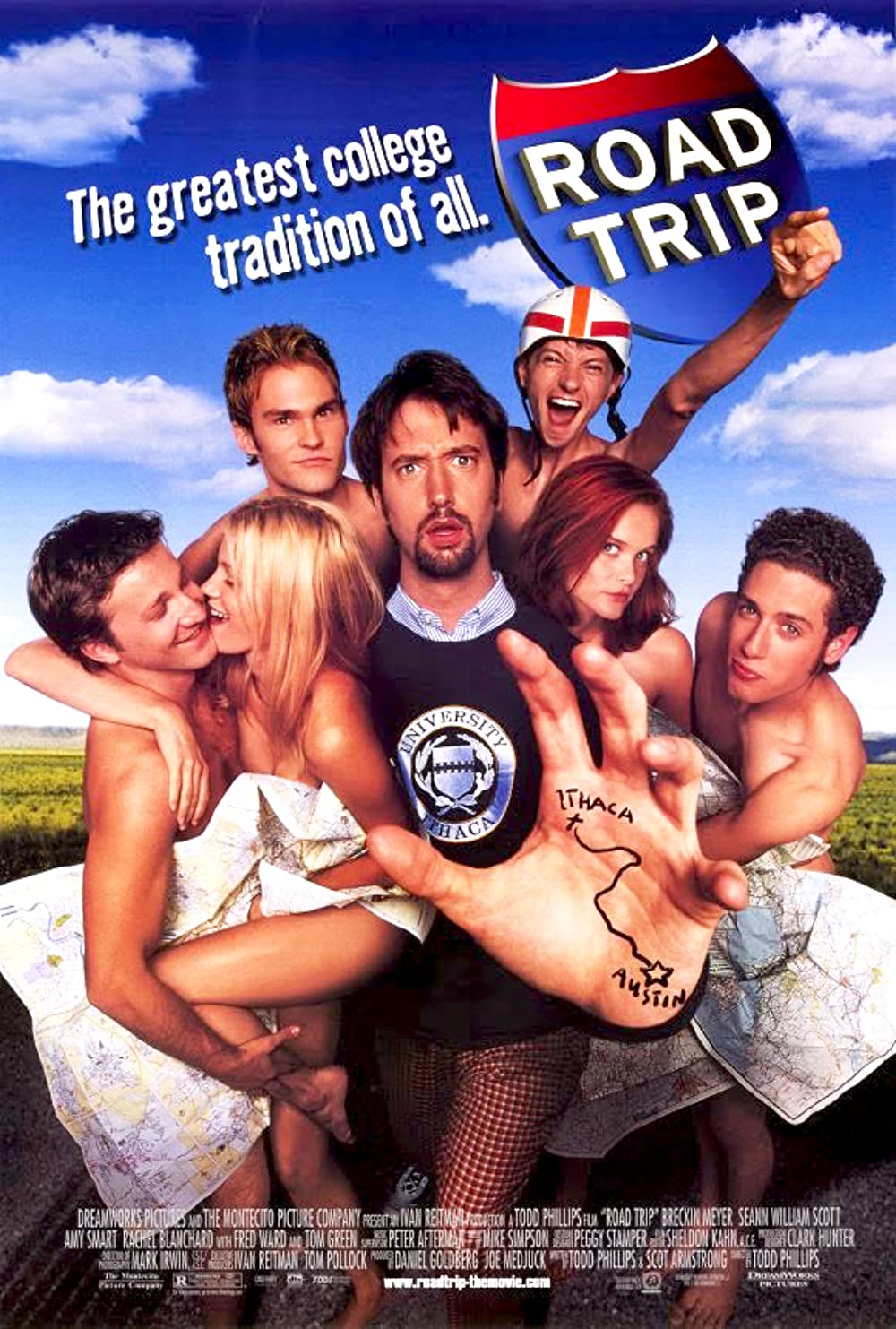
 ROAD TRIP (2000)
Review by Jerry Saravia
Originally viewed on August 1st, 2001
Sex has become so mainstream in its explicitness that it has lost all its mystery. 1999's "American Pie" proved that sex sells, particularly in teen sex comedies. Today's teenagers need not worry about school or their prospective futures. All they apparently think about is sex, and nothing else. Dating is a
thing of the past, just get down and dirty on the first date and worry about relationships later (there was the phenomenon of date rape, still a possibility but now it is mulled over in favor of getting down and dirty). "Road Trip" is simply a sex comedy, and the emphasis is clearly sexual with comedic overtones.

Breckin Meyer, who has played his share of stoners, is the sweet, clean-cut guy named Josh this time. Gasp! He now attends a university in Ithaca where he is failing a course that could get him in serious academic trouble. But a passing grade is the least of his worries - he is too wrapped in a long-distance
relationship. His childhood sweetheart, Tiffany (Rachel Blanchard), is attending the University of Austin and Josh misses her greatly. What is Josh going to do, and how can he prevent himself from meeting other sexy chicks, including the luscious Beth (Amy Smart)?

Needless to say, Josh and Beth end up between the sheets and record the event with a trusty camcorder (You know it is the 21st century when all private activities are recorded with a camcorder). Josh is no longer sullen and inhibited, though the taped event is now lost! Apparently, one of his buddies
mailed the wrong tape to Josh's girlfriend (initially, Josh just recorded a taped message to her). Josh enlists the help of his buddies to go on a road trip to Austin to prevent Tiffany from receiving the tape. Josh's buddies include Kyle (DJ Qualls), a nerd who masturbates endlessly, Rubin (Paulo Costanzo), an
intellectual pot-smoker and E.L. (Seann William Scott), the pseudo-cool guy who doesn't like the concept of learning. Together they endure one mishap after another, including car explosions, hot babes, blind women, irate pistol-packing fathers, an African-American fraternity, and more hot babes.

"Road Trip" starts with the time-honored tradition of the road picture though we barely get much of a glimpse of America - an 1,800 mile trip from Ithaca, New York to Austin, Texas must have some locations of interest. No matter, this movie is all about sex, sex and more sex - oh, and there is a package to intercept. What we merely get in "Road Trip" is a host of comic situations. At the sorority, Kyle gets his chance for a real romp in the hay with a sensual BBW. E.L. and Josh go to a sperm clinic where E.L. receives unlikely professional help. Rubin merely smokes weed and thinks too much to worry about sex. Meanwhile, the buddy who decided to stay in Ithaca, Barry (Tom Green), an
eight-year resident of the university, spends his time trying to get a mouse eaten by a snake. Considering Green's shenanigans of late, this whole subplot should come as no surprise.

"Road Trip" is fitfully funny and at times, surprisingly sweet-tempered. I like the idea that the film does not aim for the gross-out gags of "American Pie" or other teen flicks. Director Todd Phillips ("Hated: The G.G. Allin Story") decides to cut back from the gross level, playing it safer than usual. This
results in numerous gags that often work, and some that are recycled from "Ferris Bueller's Day Off" (the car bit is an obvious lift). The blind woman scene works because she sees more than she lets on when confronted by E.L. The restaurant scene is a let-down but some gags and situational humor work in spite of themselves. I was surprised how much I laughed during the film, particularly at Tom Green who serves as the film's narrator (his university tour guide scenes are hilarious). The actors are all appealing and fun personalities to watch and the humor never sinks lower than a toilet bowl. But I must ask again as I did when I saw "American Pie" - do freshman college students have anything else on
their minds besides sex? Apparently not.

Footnote: The video camcorder incident is in question over authenticity. There is a scene where Beth tapes an interview with Josh before getting hot and heavy with him while the camera records the whole event. The camcorder used is a digital Sony DV camera. In order to record anything, the camera must have a mini-DV tape in it, otherwise recording is impossible (as with all camcorders). It is clear that the DV camera is recording because the red light indicator is on. Therefore, a mini-DV tape must be in the camera. Later on, Josh reluctantly shows his buddies the taped event. Only the tape is now full-size, 1/2 inch VHS tape. This can only mean that Josh either simultaneously recorded the event on DV and VHS or dubbed the mini-DV tape to VHS. No actual scene shows this, and it is also clear that Beth set the recording on for the camcorder only (despite it being viewed on Josh's TV monitor). Since he shows his buddies the wrong tape, one can assume that the DV tape was mailed to Tiffany. Since a later scene
shows Tiffany viewing a VHS tape, then it is clear the filmmakers are unaware of how DV cameras work, or Josh taped his interview on DV and then transferred it to VHS so Tiffany could view it on her TV. Either way, a transitional scene is missing. Oh, the details we video nuts must worry about.

Teen Movie Spoof Poops on itself

NOT ANOTHER TEEN MOVIE (2001)
Reviewed by Jerry Saravia
Originally viewed on May 23rd, 2002

One mention I will make of teen movies since the inexplicable success of "She's All That" is that they were all recycled from Hollywood romances of the past that have since been deemed old-fashioned and outdated. But if any filmmaker paid the slightest attention from anything starring Freddie Prinze,
Jr. and Rachael Leigh Cook, it is that they were all self-reflective of John Hughes teenage comedies from the 1980's. They were in on the joke yet managed to take themselves seriously, as if we cared. "Not Another Teen Movie" mocks all the popular teen movies from the 80's and 90's. Some jokes hit but many miss, yet there are some occasional laughs.

The plot is a direct steal from "She's All That," which stole its plot from "My Fair Lady" which of course lifted its ideas from "Pygmalion." Anyways, we have the Rachael Leigh Cook-lookalike, Janey Briggs (Chyler Leigh), the supposedly ugly duckling who is unknowingly part of a bet involving the prom. The popular jock in the Freddie Prinze mode is Jake (Chris Evans). So that is all there is to it. All the shenanigans take place at John Hughes High School. We have an Anthony Michael Hall lookalike who wants to get laid at graduation, even though he and his pals are freshmen. We have Jake's
incestual sister (Mia Kirshner), who has a plan à la "Cruel Intentions." And there are gross-out gags. Lots of them. Too many of them, including one unnecessary toilet sequence that is perhaps as gross as anything you might see in "American Pie" or "There's Something About Mary." And another involves
a cringe-inducing scene involving kissing and tonguing between two female students, one of whom is far more mature than the other.

Well, here is the list of movies that serve as homage or as just plain rip-off material. We have "The Breakfast Club," "Pretty in Pink," "Almost Famous," "Sixteen Candles," "Risky Business," "Ferris Bueller's Day Off," "American Pie," "American Beauty," "Bring It On," and "Election." Of course,
there are so many more. The funniest bit is the detention sequence involving the Anthony Michael Hall character aping Judd Nelson's mannerisms perfectly from "The Breakfast Club" with a nice visit from Paul Gleason as Richard Vernon, reprising his role from that film and wearing practically the same
clothes. It is laugh-out-loud funny. I also liked a scene involving Jake and his father (Lyman Ward, Ferris Bueller's dad) - it may make one uneasy but it is original and tastefully done. And who can not laugh at lovely and pouty Molly Ringwald's surprise cameo!

On the whole, the movie depends too much on gross gags and bodily fluids for jokes - it should have taken a more satirical approach rather than repeating the same exact gags from other movies. "Not Another Teen Movie" forgets to spin its own snappy rhythms - more cleverness and less barfing would have made it special. To mock or goof off on films, you have to play it straight. It was the rule of thumb established by the spoof that made spoofs a household name, "Airplane." "Not Another Teen Movie" is just that - another teen movie.

Sunday, May 8, 2022

Need to pay attention

MONSTER'S BALL (2001)
Reviewed by Jerry Saravia
Originally viewed on March 6th, 2001
As much as I love some of Spike Lee's blunt attacks on racism in contemporary America, I do prefer the more implied notions of race in films like Carl Franklin's "One False Move" or John Sayles's "Lone Star" and "Passion Fish." "Monster's Ball" is another one of those reflective, absorbing Southern tales,
where racism exists in some people but also where needs are often met firsthand, regardless of a person's race.

Billy Bob Thornton plays Hank Gratowski, an admired Georgia corrections officer who works with his son (Heath Ledger, in an astonishing performance), also a corrections officer. They live together in a big house, along with Hank's racist, sickly father (Peter Boyle) who despises weakness though he is a man of a weak heart. Racism and hatred filter in this family though Hank's son is anything but racist. He makes friends with two young black kids in the neighborhood, and Hank can't help but hate his son for being friendly with blacks. The only consolation in this unhappy existence is a prostitute whom Hank and his son share (and we suspect, Hank's father might have in the past as well).

An execution of a death-row inmate, Lawrence (Sean Combs), is about to take place and Hank is in charge of supervising it. Lawrence's son is not ready to see his dad go whereas Lawrence's wife, Leticia (Halle Berry), wants to move on. Lawrence makes portraits of Hank and his son, making it harder to see a man die by electrocution. Hank's son can't take it, vomiting on the way to deliver the inmate to his death. Hurt, despair, anxiety, depression, depersonalized sex and lack of communication center in on the relationships of all these people, and it will take a miracle to bring closure and some measured happiness to any one of them.

Director Marc Forster ("Everything Put Together") could easily lead the film into any road well travelled by other hack Hollywood directors. We could have entered a world of sentimentality where all wrongs are righted and all rights are wronged. Instead, he opts for a more daring approach. It happens when Hank, who quits his corrections job and decides to own a gas station, finds Leticia on
the street begging for help when her son is killed in a hit-and-run accident. Hank has just gone through a similar hell when his own son meets an unfortunate end, and can't find solace at home with his father. These people need consolation, some pleasure of being needed, and that is at the heart of "Monster's Ball."

Like most great films, this one is dependent on reversing expectations completely. There are moments when Hank might react a certain way when seeing the same black kids he shouted at in an earlier scene, but he doesn't. Hank's father confronts Leticia in one scene, and we think that a shouting match is
about to take place, but it doesn't. As written by Milo Addica and Will Rokos, the film observes the humanity in Hank and Leticia but it also looks at how they might behave in real life. People do not usually shout much or say much, they are most interesting when we see them thinking. And that is the observation in the extremely moving final shot where we observe Leticia in a moment of self-reflection that seems more comforting and reflective than any words can say.

Billy Bob Thornton is one of the most magnetic, dynamic actors in cinema today, and I am still not sure how he does it. He gave us such incredible portraits in films as diverse as "Sling Blade," "One False Move," "A Simple Plan" and the more recent "The Man Who Wasn't There." I am betting it is those piercing eyes that stay glued to you, plus his extremely minimalist body language that keeps us watching. Nothing is more evocative when he sits quietly and passively, listening to Leticia laugh and cry at her own downward spiral in life. He listens, nods and smiles, and listening is as important as anything else an actor can do. Thornton is a master of it because we know his mind is at work,
even when listening.

Halle Berry is the most surprising in the film, showing a mental, emotional breakdown that is enthralling and devastating to watch. But she is equally adept, again, at listening. Consider the scene where her husband, Lawrence, tries to explain to his son what will happen to him. The look in her eyes
suggests pain and possibly regret, regret that she did not see how things might have been different. That makes her scenes with her son just as powerful, where she cajoles him into losing weight so he will not look like a pig anymore. Berry has not been this forceful or salient for quite some time, and she has matured greatly into a terrific character actress.

Like the current "In the Bedroom," "Monster's Ball" is all about gestures, silences, reactions, and physical space. It is a film to absorb as it tells its story slowly, allowing us to revel in the nuances and depth of the relationship between Hank and Leticia. They form a bond by mutual need for each other, to
cling to someone who is not full of hate. It is a love story, but brimming with pain and hope for the future, and neither one pays much attention to their race or beliefs. And it is all based on the need to do so.

Entering a magical land through the closet

 THE CHRONICLES OF NARNIA: 
THE LION, THE WITCH AND THE WARDROBE (2005)
Reviewed by Jerry Saravia
Viewed on January 27th, 2006

I have only a faint recollection of C.S. Lewis's book of "The Lion, the Witch, and the Wardrobe" but I do recall a sense of wonder and magic when I read it. Those qualities are missing in the short-shrifted adaptation called "The Chronicles of Narnia: The Lion, the Witch, and the Wardrobe."

The film takes place in the English countryside outside of London during World War II where four siblings, Peter (William Moseley), Lucy (Georgie Henley), Susan (Anna Popplewell) and Edmund
Pevensie (Skandar Keynes), are living in a spacious manor of sorts with Professor Kirke (Jim Broadbent). It is so spacious that it makes for an ideal game of hide and seek. While trying to hide,
Lucy, the youngest, enters a room where an inviting closet exists and nothing else. As she opens the closet door and gets past the fur coats, she enters the world of snow-covered Narnia. At first, Lucy notices a strange lamp post and then she finds a faun named Mr. Tumnus (James McAvoy) who invites her for tea at his gray cavernous home. He reveals that he is not supposed to be talking to a human since humans have never been seen in Narnia and if one is spotted, they are to be kidnapped and sent
to the White Witch (Tilda Swinton). The White Witch controls Narnia and had abolished Christmas for almost a century, condemning the place to endless winter (a timely idea considering the ozone layer nowadays).

Lucy goes back to the house and tells her siblings about her adventures but they don't believe her. One night, Edmund follows Lucy to the wardrobe closet and, presto, we are back in Narnia. Edmund encounters the White Witch who temps him with Turkish Delights in exchange for meeting the other humans. Before you know it, Peter and Susan soon join the fantasy land and we encounter talking beavers, a majestic lion named Aslan (voiced by Liam Neeson), fierce Minotaurs, angry wolves, more
fauns, cyclopses, centaurs, dwarves, etc. For effects, there are fiery spells, clashes with swords that emit lightning sparks and multiple arrows fired into the sky.

But something pervades through this live-action version of Lewis's much admired text - a feeling of emptiness. The movie has everything money can buy for a cherished fable (including a lavish battle sequence) but no sense of wonder or adventure. Excepting little Lucy, the other kids find nothing to be awed by. Once they are in Narnia, they are befuddled but not amazed. Wouldn't you be amazed if you saw a faun, a unicorn or an icy castle? When a beaver approaches them and talks to them, the kids react as if they've seen talking beavers before (maybe if you have had one had too many drinks at an English pub).

Then there is Peter, the eldest sibling, who can't bring himself to kill a salivating wolf (though he does succeed later on), and suddenly he is knighted! He actually leads the army to fight the vaster White Witch's army! The transition is nonexistent and the seams show through the truncated storyline - the movie compresses many events from the book but it has no sweep or grandeur. That is fine since it doesn't need to, but there is a disturbing lack of intimacy with the characters. They exist more in a void than in the real, fantastical world.

I wish I could admire "Chronicles of Narnia" on the level that the critics have, but the kids never convinced me that they were have an amazing adventure. The movie is strictly conservative
moviemaking - far lighter fare than "Lord of the Rings" or "Harry Potter." For some, this may be a blessing to have a family fantasy tale without blood and gore (and complete with a Christian
subtext unintended by C.S. Lewis). I am all for that but "Narnia" is more of a fairy tale and though it has the occasional confidence of one, it doesn't act like one.

Saturday, May 7, 2022

More wizardry and malevolent forces at Hogwarts

 HARRY POTTER 
AND THE CHAMBER OF SECRETS (2002)
Reviewed by Jerry Saravia

"Harry Potter and the Chamber of Secrets" is a vast improvement over the awkward, toothless first "Harry Potter" film. This one is livelier, more focused and has a little charm but it still suffers due
to a fairly bland leading hero. 

Harry Potter (Daniel Radcliffe), the little wizard that could, is back at the Hogwarts School for Witchcraft and Wizardry for his sophomore year with his old schoolmates, the smart Hermione (Emma Watson) and the red-haired Ron (Rupert Grint), who manages to carry a faulty wand. We still have the crusty old Professor Dumbledore (Richard Harris, in his last role), the absolute Professor McGonogall (Maggie Smith), and the stern Professor Snape (Alan Rickman). A newbie arrives at Hogwarts as one of the most memorable characters in the film, the allegedly droll, conceited Gilderoy Lockhart (Kenneth Branagh), who spends more time promoting his book "Magical Me" than teaching his students the dark arts.

Something wicked is happening at Hogwarts, however. There is a chamber of secrets in the school's corridors, a chamber that can't be easily opened. A malevolent spirit exists that puts some students in a "petrified" state, a state of frozen shock. Something dark and mysterious resides in the school but who's behind it? Any of the professors? Perhaps Harry's nemesis, Draco (Tom Felton) or his father, Lucius (a superb Jason Issacs)? Or does the house elf, Dobby, know more than he's letting on? Can Harry Potter save the day and arrive at the truth with Hermione and Ron? Naturally.

For scenes of incredible effects and magic, there is a flying car, a slaying giant snake, animated portraits and newspapers, nasty spiders, another Quidditch match that is as spellbinding as the original, cloaks that make one invisible, giants, malicious trees, and much more.

What the film lacks is a distinctive personality. As directed by Christopher Columbus, the movie still has an air of indifference, though it is darker and richer than what we have seen before. The problem may be linked to Daniel Radcliffe who doesn't have much in the way of charisma to hook us in as Harry Potter - he is appropriately wild-eyed but not much more (he seems more alive when in jeopardy). The supporting cast is far more animated, including Branagh's scene-stealing role and the quirky Dobby,
who is the most agitated elf I've seen in some time.

I liked what I saw in "Harry Potter and the Chamber of Secrets" and I enjoyed it (though be warned that the movie is two hours and forty minutes long). I am just hoping that in future installments (we have at least five more to go), Harry grows up a little and develops an interest in things besides magic. After all, he may be a wizard but he is only human.

The young wizard's debut needed more magic

HARRY POTTER 
AND THE SORCERER'S STONE (2001)
Reviewed by Jerry Saravia
Original review from December 8th, 2001

Harry Potter has become a hero for children and adults alike in the last couple of years. I suppose this is a good thing considering that Potter's origins stem from books and if young kids are reading books, then that is always cause for celebration. I have not read any of the books but I am considering reading the
first book, just to get a taste of what is delighting kids so much nowadays. The movie version of "Harry Potter and the Sorcerer's Stone" gives me little enthusiasm though, a loud, frenetic comic book movie that has plenty of good ideas but has no idea how to orchestrate them into a whole movie.

In the opening scene, Harry Potter is an abandoned baby found by wizards from the Hogwarts school who is given to a good family to be taken care of. Good family? I should think not. The next scene shows an 11-year-old Harry Potter (played by Daniel Radcliffe), as we learn that his parents were killed by an evil wizard named Voldemort who left Harry with a scar on his forehead. Potter lives with his mother's sister and her family, which includes her mail-hating husband and their son. They are all mean to Harry and keep him in a closet staircase as if he was an animal. Letters are sent everyday to Harry from owls. It turns out the letters are from the Hogwarts School of Wizardry and Witchcraft
and they want Harry to attend. Thanks to a hulking man named Rubeus Hagrid (Robbie Coltrane), Harry is sent off to the school, picking up an appropriate wand and other magic devices for his training (there is even a bank for wizards!) He arrives at the school and becomes friends with Ron Weasley (Rupert Grint) and Hermione Granger (Emma Watson), though Granger seems to be the one who actually reads the assigned books. So we see floating candles above the dining room, snappy
professors, goblins, rampaging giant trolls, mirrors that may tell information about the past and future, invisible cloaks, and a dangerous game called Quidditch. Oh, and how can one omit the use of magic brooms! I have heard complaints from real witches that brooms are to be ridden with the bundle of
straw on the front, not the back, and am still waiting for a movie to get that detail right.

Most of this sounds like great fun but doesn't appear to be much fun. But I felt curiously uninvolved throughout "Harry Potter," as well as detached from the characters, including the beaming Mr. Potter himself. He is always smiling and almost always triumphant but he possesses no individual personality. It is not Radcliffe's fault but one wishes director Columbus and writer Steven Kloves ("The Fabulous Baker Boys") instilled some dimension in this brave tyke. Same with most of the other young wizards except for the clever Hermione, a girl who spends her time telling Potter and Weasley secrets of wizardry and the inner secrets of the teachers at Hogwarts. She is strong and determined and educated, qualities that Potter seems to lack.

"Harry Potter" never quite feels magical or joyous. There is no actual sense of fun or adventure either. Part of the problem is the film has too many close-ups which cramp the screen - there are too few exterior shots to convey a mood or sense of place. The entrance to the Hogwarts school is mystical and magical but what takes place inside is not. Columbus's use of close-ups in movies like "Mrs.
Doubtfire" and "Home Alone" worked but a magical adventure like this needs some spaciousness, some sense of mysticism. After all, this world in "Harry Potter" is entirely fictional. The special-effects are well-done but are too frenzied and cramped, as if the editor lost patience and kept cutting away too fast before the next scene took place. The Quidditch sequence is a highlight as it depicts a game where an orb has to be caught and thrown through a hoop by the players riding on brooms - sort of a high-flying hockey game. But as soon as the sequence begins, there is discoloration in the scene, as if it was overcast considering it takes place outdoors. The beginning of the scene shows vibrant colors but then the special effects take over and desaturate whatever color there was. This is one more example why CGI effects do not always work, and one of the reasons why similar outdoor shots in "Gladiator," specifically the arena, also looked faded and colorless. Other effects involving the giant troll and a centaur are wondrous to watch but the three-headed dog leaves something to be desired.

On the plus side, the performances by titanic actors like Alan Rickman (my favorite in this cast) as Professor Snape, the teacher of the dark arts, Maggie Smith as the stern Headmistress Mistress McGonagall (who can turn into a cat), and Richard Harris, the serene Albus Dumbledore who looks like Merlin, are all terrific and filled with wit and energy. Unfortunately, they do not occupy much
screen time, leaving it all to the tykes who did not exactly rouse me or get me in the mood for their adventures. Yes, "Harry Potter" might please kids and readers of the best-selling books no matter what I have to say. But consider "Young Sherlock Holmes," written by Mr. Columbus himself, an imagined look at Holmes in his youth solving a case in London. It was involving and exciting and had a definite sense of adventure and some magic. Also worth seeing is "The Witches," which is about tykes that change into rats under the spell of a mean witch (Anjelica Huston). Both of these films involved kids or teens caught in a dangerous world of supernatural circumstances, some seen and others unseen. The elements of a great adventure about a young wizard in training had lots of potential. Columbus turns it into a harmless, impersonal film. Maybe he just needed a magic wand.

Detention if you use magic outside the school!

 HARRY POTTER 
AND THE ORDER OF THE PHOENIX (2007)
Reviewed by Jerry Saravia
Mr. Harry Potter continues to wield his magic wand, and has yet to cross into "American Pie" territory. This is good news because the films could have easily focused more on romance than magic, witchcraft
and the forbidden. The fifth adaptation of the highly popular J.K. Rowling books has matriculated nicely into a new cinematic, richer chapter. I wouldn't say it is better than "Prisoner of Azkaban" but it
is almost on par with the dreary look of "Goblet of Fire."

When we last saw our bespectacled Harry, he survived the death grip of the evil lord Voldemort (Ralph Fiennes), though it did cost the life of one other wizard. Harry is also prone to using his magic outside of his Hogwarts school in defense of other evil spirits, especially the faceless Dementors (first seen in "Prisoner of Azkaban"). Unfortunately, the Ministry of Magic has threatened to expel Harry for
using magic outside school grounds (Time for detention, Mr. Potter!) However, with Professor Dumbledore (Michael Gambon) at his side, Harry explains that Voldemort is back. No one from the faculty believes him, but he is allowed to stay in school.

More havoc ensues when a new Defense of the Dark Arts teacher, the always beaming and severely critical disciplinarian Dolores Umbridge (superbly played by Imelda Staunton), begins to taunt students, proclaiming new rules left and right, and essentially destroying everyone's spirit - as if Voldemort didn't do enough to crush spirits. Meanwhile, Harry builds an army of Hogwarts students to help defeat Ms. Umbridge, harnessing their abilities to think of good, pleasant thoughts. There is enough dreariness in the dank world of Hogwarts. 

Adapted from the longest novel in the series, "Order of the Phoenix" is actually the shortest in the film series. It contains just about everything you would expect from Harry Potter. There are angry
centaurs, magic spells, a dimwitted giant who looks like Alfred E. Newman, the shrieking Dementors, animated portraitures, newspapers with animated pictures, flying brooms, angrier house elves, etc. More crucially successful than all the impressive special-effects (which are kept to a minimum) is the emphasis on Harry Potter's mental condition. He stands up to everyone, including Professor Dumbledore. He has constant nightmares about the evil Voldemort and fears that he may share the dark lord's powers. Harry also gets his first romantic kiss with fellow student, Cho Chang (Katie Leung), but wizardry takes precedence over romance.

As much as I like this entry in the "Harry Potter" series, I can't say I like it as much as "Goblet of Fire" ("Prisoner of Azkaban" still stands head and tails above the rest). This adaptation curtails too many characters and motivations. It is nice to see the giant Hagrid back (once again played by Robbie Coltrane) but his character is short-shrifted, as is his half-brother Grawp, a far bigger giant (and a
wonderful cinematic creation to behold). Voldemort (Ralph Fiennes) appears but all too briefly, though I sense his presence will grow in the next chapter. We get the new female student for Harry, the lovely
Katie Leung as the aforementioned Cho Chang, but her character also seems to have been left on the cutting room floor (especially when she is central to a major plot development). Even Ron (Rupert Grint) and Hermione (Emma Watson), Harry Potter's most trustworthy allies, seem to drift in the background - their only purpose is to help Harry confront his demons.

We do see a brief, chilling flashback that lends unexpected new depth to the Potions Master teacher, Snape (Alan Rickman). There is also much more time devoted to Harry's godfather, Sirius Black (Gary
Oldman), who has a distinctive fighting style for a wizard. And we get a new character, the deeply mad, wraithlike Death-Eater, Bellatrix Lestrange (Helena Bonham Carter), who breaks out of the Azkaban Prison and is Sirius Black's cousin.

Given how difficult it is to keep track of all the characters (and many of which I have excluded), "Harry Potter and the Order of the Phoenix" is still magical, heartfelt and deeply effective, though noticeably and understandably darker in tone. Now that Harry Potter and friends are seen flying in their brooms over the city of London, I wonder if anyone from the outside will ever wonder what kind of
bureaucratic and nonsensical spell has been cast at the Hogwarts school.

Youthful Wizard's hormones are raging

 HARRY POTTER 
AND THE GOBLET OF FIRE (2005)
Reviewed by Jerry Saravia

I dismissed the original "Harry Potter" film as devoid of magic and a sense of adventure. Now, after seeing "Chamber of Secrets" and "Prisoner of Azkaban," I find the stories are more gripping and have
a sense of fun and a twinkle of glee. "Goblet of Fire" is the fourth entry in the "Harry Potter" series and it is a startling, scary and atmospheric ride, as stirring as the "Prisoner of Azkaban" (though not
as smoothly directed).

Those of you who are devotees of J.K. Rowling's literary series are well aware of what is in store for "Goblet of Fire." This time, Harry Potter (Daniel Radcliffe), the teen wizard, is now the tender age of 14 and his hormones are raging. A ball, known as the Yule Ball, is scheduled for all the students at Hogwarts, though getting a date is harder for Harry and especially Ron (Rupert Grint), the red-headed colleague who certainly has a thing for Hermione Granger (Emma Watson), the know-it-all who
is still smarter than anyone else. An upcoming Tri-Wizard tournament is also scheduled for students around the world, specifically four champions. One of them is a Bulgarian wizard named Vikton Krum
(Stanislav Ianevski), a Quidditch expert, and the other is a blue-clad French girl from the Beauxbaton school. The catch is that the competing wizard has to be aged 17 or older yet Harry Potter's name inadvertently ends up in the goblet of fire, to the dismay of all students and the jealousy of his trusted friend, Ron. Who slipped Harry's name in the goblet? I won't say.

If you want plots and subplots and character details, then you can't find anything better nowadays than Harry Potter. There is so much to keep track of that it is like remembering the names of all the members of the Bush administration since Bush took office. Professor Dumbledore (Michael Gambon) is still the illustrated speaker for all Hogwarts students. Ron wants Hermione yet she has her eye on Krum. A new teacher of the Dark Arts is the seemingly alcoholic Alastor "Mad Eye" Moody (Brendan Gleeson), who has a false, swiveling eye that comes equipped with a zoom lens! Miranda Richardson appears as a gossip columnist, Rita Skeeter, who's too full of herself as she gathers for the next scoop (she
and Gilderoy Lockhart would make a nice pair). The giant Hagrid (Robbie Coltrane), the gamekeeper, finally finds love with Madame Maxine (Frances de la Tour), the headmistress of Beauxbaton.

The evil force known as Voldemort (Ralph Fiennes) still presides over the school and Harry wants his revenge since Voldemort killed his parents once upon a time. Along the way, harried Harry has to come against the Death-Eaters, a fearsome dragon (the most convincing I've seen thus far on film), tough underwater trials with monstrous mermaids, an endless maze with unseen forces, the return of Harry's godfather Sirius Black (Gary Oldman) in ember form, and much more.

There is so much to take in that you'll be left bewildered and befuddled (it helps to familiarize oneself with the films or the books). "Goblet of Fire," like the last entry, is not overstuffed though it is supremely detailed. The story still works and moves along briskly enough, and it is getting progressively darker. Brit director Mike Newell infuses the fantasy with touches of whimsy and pure magic, not to mention the feeling of puberty breaking out of these wizards.

Since "Prisoner of Azkaban," Daniel Radcliffe has finally proven to develop a personality that brings the urgency out of Rowling's textual hero, including his doubts, his shyness about girls and the lack of ego about being a celebrity after having defeated a dragon. It is Radcliffe's humanity that makes us care for his plight. The trials and tribulations of our favorite youthful wizard continue.

Harry and company, time to prescribe some antidepressants!

 HARRY POTTER AND THE PRISONER OF AZKABAN (2004)
Reviewed by Jerry Saravia
I must say that I am slowly becoming a Harry Potter fan. "Chamber of Secrets" was far superior to the original film but "Prisoner of Azkaban," helmed by Mexican director Alfonso Cuaron, is an
unpredictable, odd and extremely sinister new film in the series - it won me over tenfold.

This time, Harry Potter (Daniel Radcliffe), our intrepid wizard, can't wait to begin a new semester at Hogwarts because his stepparents, the Dursleys, are driving him nuts. He is so incensed with them that he literally changes one of his aunts into a flying balloon! Before you know it, Harry's school friends whisk him away in a flying car back to the prospective school of learning wizardry.

It is business as usual although something wicked this way comes (a choir even sings the words to make sure we get the point). Something far darker and more sinister than Harry has ever confronted before is making its way. A convicted murderer named Sirius Black (Gary Oldman) is on the loose and purportedly after Harry since he allegedly killed Harry's parents. There is also a rat-faced human named Peter Pettigrew (Timothy Spall), who can change into a rat and who may not appear to be what he first seems. Added to the mix is the unseen, evil force known as Lord Voldemort and a host of ghostly manifestations known as the Dementors, who emit negative energy and can make you feel depressed (It is high time for Potter and company to start prescribing anti-depressants). The Dementors are after Sirius Black and are attempting to protect the school from Black, though they seem to do more harm than good.

So let's see: who are the new members of the teaching faculty? We have the creepy Professor Lupin (David Thewlis), who may be trying to protect our youthful wizard with no pimples. There is also
newcomer Professor Sybil Trelawney (Emma Thompson, almost unrecognizable), who sees death in Harry's future thanks to tea leaves in tea cups. Everyone seems standoffish, including the usual
members of the faculty such as the sneering Professor Snape (Alan Rickman), Professor Dumbledore (reliable Michael Gambon replacing the late Richard Harris), the sagest of all and, if you are
alert, you'll note the all too brief appearance of Maggie Smith as Professor McGonagall. And if you are real quick, you'll spot Julie Christie in a cameo as someone who knows the truth regarding
Harry's real parents.

"Harry Potter and the Prisoner of Azkaban" is certainly chock full of characters and situations that require a little note-taking to keep track (post-its might help for the DVD viewer). What is of special
note in this film is the glumness and darker tone. Director Alfonso Cuaron (who helmed the underwhelming "Y Tu Mama Tambien") brings a level of playfulness to it, as should be required of all fantasies, but there is also a sense of unease. Thanks to stunning art-direction and fluid camerawork, the film is just as uninviting as it is inviting. Cuaron sweeps us away into a world of time travel, ominous
incantations uttered before an ominous mirror, werewolves, misty fog by the moonlight, wraiths (Dementors) that resemble the Ring-Wraiths from "Lord of the Rings," flying cars, magic wands,
a little more Quidditch play with flying brooms, a spectral bus, a talking shrunken head, need I say more?

"Prisoner of Azkaban" remains the oddest Harry Potter film by far, evoking more dread than whimsy (which is not a bad thing). Its look and feel resembles Nicholas Roeg's equally dark and foreboding
"The Witches." "Azkaban" is the one film in this series that makes me feel rather uncomfortable, despite how entertaining and dazzling it often is. Everyone in this grand cast performs up to expectations but it is Daniel Radcliffe who surprises me the most. Radcliffe has brought
a sense of urgency and empathy to his role as Potter - this is not some effects-filled bombast with characterless ciphers. In "Sorcerer's Stone," Radcliffe was a bland, undefined little tyke. Now he has
consumed the role and made it his own and I am proud to say it is the best performance in the film.

"Harry Potter and the Prisoner of Azkaban" is unique, inventive, and tantalizing. Its sense of dread may scare away the tykes, though they probably have the read the book and know what to expect.
Knowing that the books encourage kids to read makes me like this film even more.