Friday, May 13, 2022

Big Brother Jesus says Be Happy

 THX 1138 (1971)
An appreciation by Jerry Saravia

George Lucas' stunning debut feature,  the dystopian "THX 1138," is something of a dark horse in his filmmaking career. It is ostensibly an Orwellian nightmare of a movie, a vision close to the heart of Orwell's "1984" yet also bearing a tenuous connection to Aldous Huxley's "Brave New World" in terms of the outlawing of emotions by consuming drugs and the illegal act of sexual activity. Cameras showing fuzzy black-and-white images are omnipresent and there is no respite from the constant surveillance. Pretty much today's world in 2022.

THX 1138 is the code name for one rebellious individual (Robert Duvall) who repairs and builds droids in a closely guarded radioactive facility. Everyone, including women, have shaved heads and seemingly frequent a booth with a Jesus reproduction as its Big Brother where you confess to the most rudimentary issues, like accidentally breaking equipment on the job. All Big Brother Jesus has to say in customary, electronic phrases is "Work hard, increase production, prevent accidents and be happy." 

THX lives with his mate, a female named LUH 3417 (Maggie McOmie), and they both watch holobroadcasts which includes a police droid beating a man repeatedly and some naked woman dancing (which THX masturbates to with the help of a device!) This world where everything looks sterile and is largely pristinely white looks clean yet...unhealthy. Everyone looks like they are staying a hospital in a city where everything is controlled by the flip of a switch. You open your medicine cabinet, immediately a voice asks, "What's wrong?" Pills are to be consumed to eliminate emotion, and we know emotions can't be controlled when you are only human. But who is controlling all this and what is the purpose other than to see how humans act when they are emotionless?

THX does the unthinkable in such a claustrophobic setting - he has sex with LUH and reassures her that they are not being watched (this is after he's not taken his pills). Actually, they are being surveilled by a bunch of older white men in some undisclosed room! Due to the violations, mind experiments are performed on THX and several injections of god knows what. Then he ends up in a vast white room prison ("white limbo") with no walls to be seen. And when the pregnant LUH is "consumed" and her name is used for a test tube fetus, THX loses it and decides it is time to break free of this hellhole.

Not much insight is gleaned from "THX 1138" in terms of who is governing the city and their overall purpose, other than controlling the population and curtailing their emotions through pills. "1984" and "Brave New World" had an entity in control and actually visible bureaucrats who explained their reasoning. In Lucas' world, we get the impression that this is a society operating under the rules of no societal interaction (one amazingly troubling and nerve-frying scene shows people walking fast in what sounds like a rumble with no particular direction or purpose). Most of "THX 1138" is the equivalent of a rumble through some abstract world one cannot comprehend. The immersive sound design by Walter Murch is invasive, frenetic and purposely distracting. The poetry of the images of such an enclosed world by cinematographers David Myers and Albert Kihn really accentuates the closed-off feeling of its sterile interiors and its characters (never seen Robert Duvall so restrained other than perhaps his consiglieri in "The Godfather"). 

I had seen "THX 1138" over 20 years ago and I thought back then that it was a bold, imaginative effort completely different from anything writer-director George Lucas had done since (his short film that this is based on, "Electronic Labyrinth: THX 1138 4EB," is just as compelling). Now I see more clearly that Lucas has captured vividly the dark spirit of Orwell without intentionally capturing the theology or philosophy (the latter only in broad strokes). When THX frees himself above the underground city, he finds solace in a sunlit, barren environment. He's all alone but at least he's free and...so are we.  

Tuesday, May 10, 2022

Adams Family Reunion

 HELLBENDER (2021)
Reviewed by Jerry Saravia

When I see a film about witches mixed with supernatural horror in the mountainous woods of some Northeastern region, I expect a blood-soaked horror movie with split-second images of all sorts of blood-soaked, ghostly manifestations. 1998's  relatively dull "The Eternal" starring Christopher Walken and the late Jason Miller in a story about a Druid witch comes to mind. Of course, there's "The Blair Witch Project" which didn't show a witch at all. "Hellbender" has plenty of blood-soaked imagery and blood pouring out of mouths and pierced fingers. If that was all there was to the film, I wouldn't recommend it yet its human story of a mother and her daughter living in seclusion in the mountains gives it unexpected humanity. And because of that, the horror really gives you a jolt.

The frail, pale-looking Zelda Adams plays Izzy, the home-schooled daughter of her mother (Toby Poser) who looks like those women in Santa Fe, New Mexico who let their gray hairs show just to be natural. Both mother and daughter are vegetarians and they eat huckleberries and twigs and assorted food items they find on their nature walks. They also have their own kick-ass punk band called "Hellbender" with Izzy on drums though nobody in this remote area has been privy to hearing them play. Nothing too abnormal here until we discover that Izzy is not allowed near other people because she is "sick." Truth is Mother is a protective 147-year-old witch and her daughter Izzy might end up being far more powerful than her mom. Izzy does not know she is a witch and somehow, when she ventures off the beaten path to meet some new kids her age and is pushed into consuming a tequila shot with an earthworm in it, the earth will start to shake and people might just die.

"Hellbender" has probably too many of those blood-soaked montages with split-second cuts but that would be its only real fault. I was quite happily entranced by "Hellbender" and the performances by Zelda Adams and Toby Poser really form the strong, familial bond between mother and daughter that may split apart. Only this is clearly no regular family drama with a wicked past shown in the powerful opening that includes a hanging. You know something is afoot when mother and daughter frolic in the snow and spit a copious amount of blood in each other's faces! And Izzy's "Happy Place" is quite mind-blowing to say the least and could give you the heebie jeebies for days.

"Hellbender" is a family affair with Zelda, Toby and John Adams (Zelda's dad and Toby's husband who has a cameo) serving as the unique writers-directors team and I'd love to see them tackle another horror piece with a family drama-of-sorts serving as its centerpiece. The most impressive and haunting performance is by Zelda, the kind of innocent looking girl you might not want to run into in the woods (think of the twins in "The Shining" and you might get an idea of how haunting and piercing a presence she is). Though Mother's past history could've used some elaboration, I overall enjoyed "Hellbender" as a captivating new horror piece that should enthrall fans of the genre, and those who love witches (real witches might get offended but, oh well). Still, there are some icky moments that will make you want to turn away. 

Monday, May 9, 2022

Treasure of Sierra Madre in a frozen hell

A SIMPLE PLAN (1998)
Reviewed By Jerry Saravia
Original review from 1998

Once in a blue moon, a film will come along and will grab you by the throat and never let go - it will also make you identify with actions committed by human behavior under certain circumstances. "A Simple Plan" is that kind of film - a rip-snorting, understated morality tale told with finesse and acute observation by a director who's not known for restraint, Sam Raimi ("Darkman," "The Evil Dead").

Bill Paxton stars as Hank Mitchell, an accountant for a small feed store in the frozen tundra of Minnesota. Only this town is not populated by the stereotypical denizens of "Fargo" - these are ordinary people about to be overcome by extraordinary circumstances. Hank is an average, righteous Joe,
living a complacent, innocent existence with his wife, Sarah (Bridget Fonda). Hank's fate lies in the woods when he's accompanied by his inarticulate brother, Jacob (Billy Bob Thornton), and his alcoholic friend, Lou (Brent Briscoe). The threesome inadvertently discover a small plane lodged in the snow, and there appears a miracle in the form of a duffel bag: millions of dollars in cash. Naturally, the three men are at odds of what to do with the money - Hank decides he'll keep it since he's an accountant and can manage it. The truth is that neither one knows how to deal with such a sticky situation. Hank tells the boys to keep their secret quiet while he does just the opposite - he tells his gleamy, smiling wife when he throws the cash on the table. Lou is no better when he spills the beans to his shouting wife. The only one who seems capable of maintaining secrecy is Jacob because he has no one to turn to
anyway, except his brother.

"A Simple Plan" shows how men and women act when money enters their path, and how their behavior changes drastically. This is not fresh cinematic territory - it's "Treasure of Sierra Madre" in a frozen hell - but what's new is how compellingly the story is told. Hank appears to be the hero of the story but
slowly he's consumed by random acts of violence, and we see that the money means more to him than anybody else. Jacob also shows that he's not a complete idiot, and we're never sure what his true agenda is outside of wanting to stay in an old, decrepit house where their father used to live. Lou is a drunk who teases Hank's manhood, and all he wants is some money to pay for late bills. Only Hank's wife remains the solely sensible one of the lot - she makes the decisions and tells Hank what course he (and the story) should take, and it always, ironically, results in calamity.

"A Simple Plan" is adapted from a 1993 novel by Scott B. Smith, who penned the script as well, but this story does not unfold under expected pretenses, namely countless twists and turns. Actually, the movie is not quite noir - you might call it a bleak drama that transcends noirish expectations with its full-blown character portrayals. There are still no heroes, but that's besides the point - these people are undone by the money that slowly reveals layers in their personalities. Amazingly, the money becomes less and less important to them as the film rolls along to a horrific finale in the woods, unveiled with
unexpected, sudden shocks and a twist of fate unheard of in the movies in quite some time.

Bill Paxton is sheer perfection as Hank, flawlessly wavering between nervousness and anxiety. Is he as righteous as he thinks he is, or does he possess a creepily violent side? Billy Bob Thornton cuts another rich characterization with his dim-witted, stringy-haired, vague Jacob, who holds a grudge against his brother, Hank, and who dreams of going on a date with a simple gal. Bridget Fonda gives one of her finest acting jobs to date as the intelligent Sarah who wants more out of her bland existence. She expresses her rage in a touching, heartfelt speech where she expounds on unaffordable dinners and coupons acquired to save money.

"A Simple Plan" moves along at a controlled pace, involving us at every turn and allowing us to empathize with each of the characters and their motives. The script doesn't satirize nor condescend to the characters. Instead, writer Smith makes them believable and congruent to their actions. This is not just the result of a stirring screenplay and weighty performances, but it is also due to Raimi's simple, unpretentious direction. And the snowy landscape and muffled sounds contribute greatly to the atmosphere - we really feel the literal coldness of the surroundings, as in "Fargo."

"A Simple Plan" may have an unsatisfying ending thematically whereas ambiguity could have resulted in richer, deeper parallels. That is surely a minor carp for a film that makes us realize the severe consequences that come with criminal actions - we must always pay a price no matter how strong we are. 

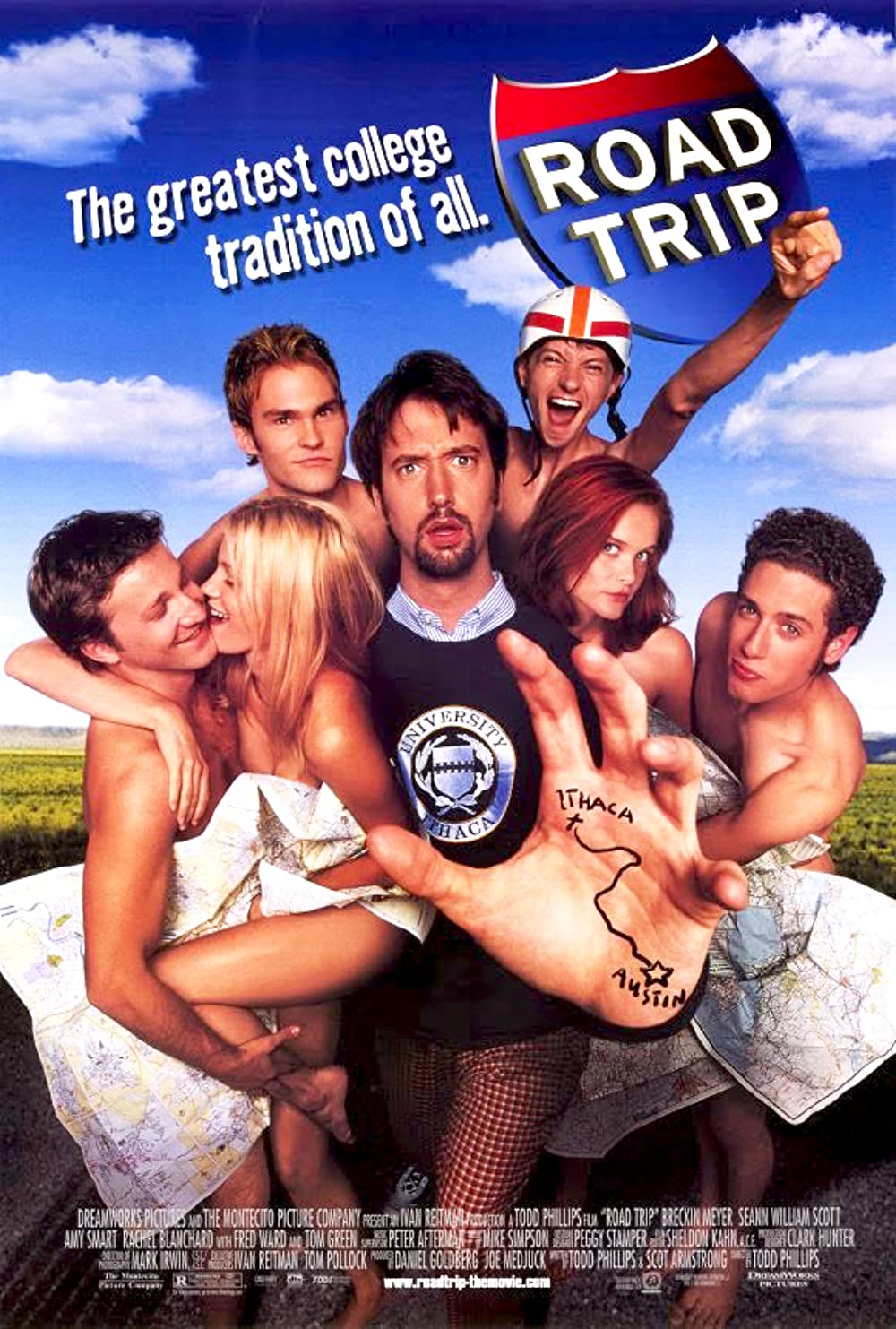
Sexual shenanigans throughout this journey

 ROAD TRIP (2000)
Review by Jerry Saravia
Originally viewed on August 1st, 2001
Sex has become so mainstream in its explicitness that it has lost all its mystery. 1999's "American Pie" proved that sex sells, particularly in teen sex comedies. Today's teenagers need not worry about school or their prospective futures. All they apparently think about is sex, and nothing else. Dating is a
thing of the past, just get down and dirty on the first date and worry about relationships later (there was the phenomenon of date rape, still a possibility but now it is mulled over in favor of getting down and dirty). "Road Trip" is simply a sex comedy, and the emphasis is clearly sexual with comedic overtones.

Breckin Meyer, who has played his share of stoners, is the sweet, clean-cut guy named Josh this time. Gasp! He now attends a university in Ithaca where he is failing a course that could get him in serious academic trouble. But a passing grade is the least of his worries - he is too wrapped in a long-distance
relationship. His childhood sweetheart, Tiffany (Rachel Blanchard), is attending the University of Austin and Josh misses her greatly. What is Josh going to do, and how can he prevent himself from meeting other sexy chicks, including the luscious Beth (Amy Smart)?

Needless to say, Josh and Beth end up between the sheets and record the event with a trusty camcorder (You know it is the 21st century when all private activities are recorded with a camcorder). Josh is no longer sullen and inhibited, though the taped event is now lost! Apparently, one of his buddies
mailed the wrong tape to Josh's girlfriend (initially, Josh just recorded a taped message to her). Josh enlists the help of his buddies to go on a road trip to Austin to prevent Tiffany from receiving the tape. Josh's buddies include Kyle (DJ Qualls), a nerd who masturbates endlessly, Rubin (Paulo Costanzo), an
intellectual pot-smoker and E.L. (Seann William Scott), the pseudo-cool guy who doesn't like the concept of learning. Together they endure one mishap after another, including car explosions, hot babes, blind women, irate pistol-packing fathers, an African-American fraternity, and more hot babes.

"Road Trip" starts with the time-honored tradition of the road picture though we barely get much of a glimpse of America - an 1,800 mile trip from Ithaca, New York to Austin, Texas must have some locations of interest. No matter, this movie is all about sex, sex and more sex - oh, and there is a package to intercept. What we merely get in "Road Trip" is a host of comic situations. At the sorority, Kyle gets his chance for a real romp in the hay with a sensual BBW. E.L. and Josh go to a sperm clinic where E.L. receives unlikely professional help. Rubin merely smokes weed and thinks too much to worry about sex. Meanwhile, the buddy who decided to stay in Ithaca, Barry (Tom Green), an
eight-year resident of the university, spends his time trying to get a mouse eaten by a snake. Considering Green's shenanigans of late, this whole subplot should come as no surprise.

"Road Trip" is fitfully funny and at times, surprisingly sweet-tempered. I like the idea that the film does not aim for the gross-out gags of "American Pie" or other teen flicks. Director Todd Phillips ("Hated: The G.G. Allin Story") decides to cut back from the gross level, playing it safer than usual. This
results in numerous gags that often work, and some that are recycled from "Ferris Bueller's Day Off" (the car bit is an obvious lift). The blind woman scene works because she sees more than she lets on when confronted by E.L. The restaurant scene is a let-down but some gags and situational humor work in spite of themselves. I was surprised how much I laughed during the film, particularly at Tom Green who serves as the film's narrator (his university tour guide scenes are hilarious). The actors are all appealing and fun personalities to watch and the humor never sinks lower than a toilet bowl. But I must ask again as I did when I saw "American Pie" - do freshman college students have anything else on
their minds besides sex? Apparently not.

Footnote: The video camcorder incident is in question over authenticity. There is a scene where Beth tapes an interview with Josh before getting hot and heavy with him while the camera records the whole event. The camcorder used is a digital Sony DV camera. In order to record anything, the camera must have a mini-DV tape in it, otherwise recording is impossible (as with all camcorders). It is clear that the DV camera is recording because the red light indicator is on. Therefore, a mini-DV tape must be in the camera. Later on, Josh reluctantly shows his buddies the taped event. Only the tape is now full-size, 1/2 inch VHS tape. This can only mean that Josh either simultaneously recorded the event on DV and VHS or dubbed the mini-DV tape to VHS. No actual scene shows this, and it is also clear that Beth set the recording on for the camcorder only (despite it being viewed on Josh's TV monitor). Since he shows his buddies the wrong tape, one can assume that the DV tape was mailed to Tiffany. Since a later scene
shows Tiffany viewing a VHS tape, then it is clear the filmmakers are unaware of how DV cameras work, or Josh taped his interview on DV and then transferred it to VHS so Tiffany could view it on her TV. Either way, a transitional scene is missing. Oh, the details we video nuts must worry about.

Teen Movie Spoof Poops on itself

NOT ANOTHER TEEN MOVIE (2001)
Reviewed by Jerry Saravia
Originally viewed on May 23rd, 2002

One mention I will make of teen movies since the inexplicable success of "She's All That" is that they were all recycled from Hollywood romances of the past that have since been deemed old-fashioned and outdated. But if any filmmaker paid the slightest attention from anything starring Freddie Prinze,
Jr. and Rachael Leigh Cook, it is that they were all self-reflective of John Hughes teenage comedies from the 1980's. They were in on the joke yet managed to take themselves seriously, as if we cared. "Not Another Teen Movie" mocks all the popular teen movies from the 80's and 90's. Some jokes hit but many miss, yet there are some occasional laughs.

The plot is a direct steal from "She's All That," which stole its plot from "My Fair Lady" which of course lifted its ideas from "Pygmalion." Anyways, we have the Rachael Leigh Cook-lookalike, Janey Briggs (Chyler Leigh), the supposedly ugly duckling who is unknowingly part of a bet involving the prom. The popular jock in the Freddie Prinze mode is Jake (Chris Evans). So that is all there is to it. All the shenanigans take place at John Hughes High School. We have an Anthony Michael Hall lookalike who wants to get laid at graduation, even though he and his pals are freshmen. We have Jake's
incestual sister (Mia Kirshner), who has a plan à la "Cruel Intentions." And there are gross-out gags. Lots of them. Too many of them, including one unnecessary toilet sequence that is perhaps as gross as anything you might see in "American Pie" or "There's Something About Mary." And another involves
a cringe-inducing scene involving kissing and tonguing between two female students, one of whom is far more mature than the other.

Well, here is the list of movies that serve as homage or as just plain rip-off material. We have "The Breakfast Club," "Pretty in Pink," "Almost Famous," "Sixteen Candles," "Risky Business," "Ferris Bueller's Day Off," "American Pie," "American Beauty," "Bring It On," and "Election." Of course,
there are so many more. The funniest bit is the detention sequence involving the Anthony Michael Hall character aping Judd Nelson's mannerisms perfectly from "The Breakfast Club" with a nice visit from Paul Gleason as Richard Vernon, reprising his role from that film and wearing practically the same
clothes. It is laugh-out-loud funny. I also liked a scene involving Jake and his father (Lyman Ward, Ferris Bueller's dad) - it may make one uneasy but it is original and tastefully done. And who can not laugh at lovely and pouty Molly Ringwald's surprise cameo!

On the whole, the movie depends too much on gross gags and bodily fluids for jokes - it should have taken a more satirical approach rather than repeating the same exact gags from other movies. "Not Another Teen Movie" forgets to spin its own snappy rhythms - more cleverness and less barfing would have made it special. To mock or goof off on films, you have to play it straight. It was the rule of thumb established by the spoof that made spoofs a household name, "Airplane." "Not Another Teen Movie" is just that - another teen movie.

Sunday, May 8, 2022

Need to pay attention

MONSTER'S BALL (2001)
Reviewed by Jerry Saravia
Originally viewed on March 6th, 2001
As much as I love some of Spike Lee's blunt attacks on racism in contemporary America, I do prefer the more implied notions of race in films like Carl Franklin's "One False Move" or John Sayles's "Lone Star" and "Passion Fish." "Monster's Ball" is another one of those reflective, absorbing Southern tales,
where racism exists in some people but also where needs are often met firsthand, regardless of a person's race.

Billy Bob Thornton plays Hank Gratowski, an admired Georgia corrections officer who works with his son (Heath Ledger, in an astonishing performance), also a corrections officer. They live together in a big house, along with Hank's racist, sickly father (Peter Boyle) who despises weakness though he is a man of a weak heart. Racism and hatred filter in this family though Hank's son is anything but racist. He makes friends with two young black kids in the neighborhood, and Hank can't help but hate his son for being friendly with blacks. The only consolation in this unhappy existence is a prostitute whom Hank and his son share (and we suspect, Hank's father might have in the past as well).

An execution of a death-row inmate, Lawrence (Sean Combs), is about to take place and Hank is in charge of supervising it. Lawrence's son is not ready to see his dad go whereas Lawrence's wife, Leticia (Halle Berry), wants to move on. Lawrence makes portraits of Hank and his son, making it harder to see a man die by electrocution. Hank's son can't take it, vomiting on the way to deliver the inmate to his death. Hurt, despair, anxiety, depression, depersonalized sex and lack of communication center in on the relationships of all these people, and it will take a miracle to bring closure and some measured happiness to any one of them.

Director Marc Forster ("Everything Put Together") could easily lead the film into any road well travelled by other hack Hollywood directors. We could have entered a world of sentimentality where all wrongs are righted and all rights are wronged. Instead, he opts for a more daring approach. It happens when Hank, who quits his corrections job and decides to own a gas station, finds Leticia on
the street begging for help when her son is killed in a hit-and-run accident. Hank has just gone through a similar hell when his own son meets an unfortunate end, and can't find solace at home with his father. These people need consolation, some pleasure of being needed, and that is at the heart of "Monster's Ball."

Like most great films, this one is dependent on reversing expectations completely. There are moments when Hank might react a certain way when seeing the same black kids he shouted at in an earlier scene, but he doesn't. Hank's father confronts Leticia in one scene, and we think that a shouting match is
about to take place, but it doesn't. As written by Milo Addica and Will Rokos, the film observes the humanity in Hank and Leticia but it also looks at how they might behave in real life. People do not usually shout much or say much, they are most interesting when we see them thinking. And that is the observation in the extremely moving final shot where we observe Leticia in a moment of self-reflection that seems more comforting and reflective than any words can say.

Billy Bob Thornton is one of the most magnetic, dynamic actors in cinema today, and I am still not sure how he does it. He gave us such incredible portraits in films as diverse as "Sling Blade," "One False Move," "A Simple Plan" and the more recent "The Man Who Wasn't There." I am betting it is those piercing eyes that stay glued to you, plus his extremely minimalist body language that keeps us watching. Nothing is more evocative when he sits quietly and passively, listening to Leticia laugh and cry at her own downward spiral in life. He listens, nods and smiles, and listening is as important as anything else an actor can do. Thornton is a master of it because we know his mind is at work,
even when listening.

Halle Berry is the most surprising in the film, showing a mental, emotional breakdown that is enthralling and devastating to watch. But she is equally adept, again, at listening. Consider the scene where her husband, Lawrence, tries to explain to his son what will happen to him. The look in her eyes
suggests pain and possibly regret, regret that she did not see how things might have been different. That makes her scenes with her son just as powerful, where she cajoles him into losing weight so he will not look like a pig anymore. Berry has not been this forceful or salient for quite some time, and she has matured greatly into a terrific character actress.

Like the current "In the Bedroom," "Monster's Ball" is all about gestures, silences, reactions, and physical space. It is a film to absorb as it tells its story slowly, allowing us to revel in the nuances and depth of the relationship between Hank and Leticia. They form a bond by mutual need for each other, to
cling to someone who is not full of hate. It is a love story, but brimming with pain and hope for the future, and neither one pays much attention to their race or beliefs. And it is all based on the need to do so.

Entering a magical land through the closet

 THE CHRONICLES OF NARNIA: 
THE LION, THE WITCH AND THE WARDROBE (2005)
Reviewed by Jerry Saravia
Viewed on January 27th, 2006

I have only a faint recollection of C.S. Lewis's book of "The Lion, the Witch, and the Wardrobe" but I do recall a sense of wonder and magic when I read it. Those qualities are missing in the short-shrifted adaptation called "The Chronicles of Narnia: The Lion, the Witch, and the Wardrobe."

The film takes place in the English countryside outside of London during World War II where four siblings, Peter (William Moseley), Lucy (Georgie Henley), Susan (Anna Popplewell) and Edmund
Pevensie (Skandar Keynes), are living in a spacious manor of sorts with Professor Kirke (Jim Broadbent). It is so spacious that it makes for an ideal game of hide and seek. While trying to hide,
Lucy, the youngest, enters a room where an inviting closet exists and nothing else. As she opens the closet door and gets past the fur coats, she enters the world of snow-covered Narnia. At first, Lucy notices a strange lamp post and then she finds a faun named Mr. Tumnus (James McAvoy) who invites her for tea at his gray cavernous home. He reveals that he is not supposed to be talking to a human since humans have never been seen in Narnia and if one is spotted, they are to be kidnapped and sent
to the White Witch (Tilda Swinton). The White Witch controls Narnia and had abolished Christmas for almost a century, condemning the place to endless winter (a timely idea considering the ozone layer nowadays).

Lucy goes back to the house and tells her siblings about her adventures but they don't believe her. One night, Edmund follows Lucy to the wardrobe closet and, presto, we are back in Narnia. Edmund encounters the White Witch who temps him with Turkish Delights in exchange for meeting the other humans. Before you know it, Peter and Susan soon join the fantasy land and we encounter talking beavers, a majestic lion named Aslan (voiced by Liam Neeson), fierce Minotaurs, angry wolves, more
fauns, cyclopses, centaurs, dwarves, etc. For effects, there are fiery spells, clashes with swords that emit lightning sparks and multiple arrows fired into the sky.

But something pervades through this live-action version of Lewis's much admired text - a feeling of emptiness. The movie has everything money can buy for a cherished fable (including a lavish battle sequence) but no sense of wonder or adventure. Excepting little Lucy, the other kids find nothing to be awed by. Once they are in Narnia, they are befuddled but not amazed. Wouldn't you be amazed if you saw a faun, a unicorn or an icy castle? When a beaver approaches them and talks to them, the kids react as if they've seen talking beavers before (maybe if you have had one had too many drinks at an English pub).

Then there is Peter, the eldest sibling, who can't bring himself to kill a salivating wolf (though he does succeed later on), and suddenly he is knighted! He actually leads the army to fight the vaster White Witch's army! The transition is nonexistent and the seams show through the truncated storyline - the movie compresses many events from the book but it has no sweep or grandeur. That is fine since it doesn't need to, but there is a disturbing lack of intimacy with the characters. They exist more in a void than in the real, fantastical world.

I wish I could admire "Chronicles of Narnia" on the level that the critics have, but the kids never convinced me that they were have an amazing adventure. The movie is strictly conservative
moviemaking - far lighter fare than "Lord of the Rings" or "Harry Potter." For some, this may be a blessing to have a family fantasy tale without blood and gore (and complete with a Christian
subtext unintended by C.S. Lewis). I am all for that but "Narnia" is more of a fairy tale and though it has the occasional confidence of one, it doesn't act like one.