Thursday, May 19, 2022

Fighting to stay alive during the Depression

 HARD TIMES (1975)
Reviewed by Jerry Saravia

Charles Bronson might have been one of the tough guy movie stars of the 70's but he acknowledged something deeper, more fundamentally human in his early roles. When Bronson fights bare knuckled, you sense that he doesn't wish to hurt his opponents. He may bruise them and knock them out but he shows compassion towards his opponent - a sense of reluctance despite wanting to win. Bronson in the 70's is wildly different from the "Death Wish" sequels and Menahem Golan pictures he made in the 1980's. In the role of a drifter in the Depression-era drama, "Hard Times," he is perfectly cast because it seemed close to the real Charles Bronson.

The year is 1933 and Chaney (Bronson) is freight-hopping from town to town trying to make a buck and move North. Chaney is something of a mystery and a no-frills type of guy - he is not out to hurt people and he keeps to himself (so was the real Bronson). He arrives in Louisiana and his interest is piqued when a bunch of men enter a warehouse and hold illegal bareknuckle fights. One of the promoters is Spencer "Speed" Weed (James Coburn, a truly energetic, colorful performance), a fairly unscrupulous opportunist who just wants enough money to gamble. Chaney tries to convince Speed that he can fight despite being older than most of the competition and I guess I could say, "Let the games begin!" but it is not that kind of movie. Speed takes Chaney to New Orleans where he beats two opponents (one of them is a bald smiling musclebound fighter memorably played by Robert Tessier) and yet none of this works out too smoothly for Speed. Speed has to deal with mobsters (one of them played by Bruce Glover, who I wished there was more of) and a wealthy seafood tycoon (Michael McGuire, a very cunning, sharply powerful presence) who wants $3,000 dollars to cover for his other opponent, a formidable fighter from Chicago whom the tycoon hopes will beat Chaney.

So there are the loan sharks and the mob circulating their efforts around Speed. Meanwhile the reluctant Chaney lives in one of the more impoverished sections of New Orleans and strikes a brief love affair with Lucy (Jill Ireland) who is not to sure of this cautious man with a heart of gold. Lucy is married but her husband is away and Chaney feels a kinship though it is not much of a romance. Curiously, many of Ireland's scenes were reportedly cut and that is a shame because Bronson and Ireland spark the screen with their limited conversations. He shows his empathy towards her, willing to help her domestic situation.

"Hard Times" is a tightly woven, sharply written and muscularly directed effort - Walter Hill's directorial debut. The pacing is swift, the fights are realistic and exciting, and the period setting and clothes are top of the line. In the midst of all this, Charles Bronson is the enigmatic and disinclined hero who comes into town like some sort of savior, an angel with a certain toughness who (SPOILER ALERT) saves Speed's butt and moves on. Chaney even gives away some of his winnings to Speed and Poe (Strother Martin), a former opium-addict and medical student who treats Chaney's cuts. Chaney is a mysterious man we should champion more often.

Wednesday, May 18, 2022

Doesn't take my breath away

 TOP GUN (1986)
A Lack of Appreciation by Jerry Saravia

Among some of the most nauseatingly sleep-inducing 1980's flicks that I can think of, "Top Gun" might indeed take the cake and top honors. It is the one that is on par with the very popular "Dirty Dancing" as bland, superficial cinema with nothing to chew on, or even lick your lips over. There is no residue, only an empty void where you struggle to remember anything of value in a sea of Dolby-ized noise.

"Top Gun" is remembered as the most jingoistic Navy recruitment film of the 1980's, reminding one of the propaganda war flicks of the 1940's except with better aerial footage. I say remembered because it is a film that I had no actual recollection of seeing. I did not see it in a theater but a friend of mine back then told me that we watched it on videocassette. I was flabbergasted by his comment at the time - we saw this movie that I had no interest in seeing? I had no memory of this and, for the record, I remember seeing David Lynch's "Dune" in theaters only because of Sting's electrifying performance and the fact that we pelted the screen with sticky, buttery popcorn (oh, what fun to be such callow teenagers). Then it hit me, "Top Gun" was just a bore, a movie about nothing and usually movies about nothing are forgotten and evaporate from the mind after one finishes watching them. Yet I saw "Dirty Dancing" on video and I must say, that movie at least had a killer oldies soundtrack (which I still have on cassette) and the famous moment where Jennifer Grey...well, you know it. Yet I hated that movie passionately because it was a stupid, unbelievable love story about a dance instructor prick played by the late Patrick Swayze who teaches Grey how to dance. At least "Dirty Dancing" had the courage of its bad movie convictions, if that makes any sense. 

I don't hate "Top Gun" - I just find it unmemorable and sleep-inducing. I have tried to watch it more than once back in the 1980's and it did nothing for me. The aerial footage of defense planes racing and swooshing through the air in formation is well-done and perfectly executed...but so what? Tom Cruise is Lt. Maverick, a wild, reckless pilot who "feels the need for speed!" Oh, brother, someone shoot me. Val Kilmer is another crazy, unpredictable pilot named the "Iceman" and they both vow to one-up and challenge each other to see who really feels the need for faster speed on board an F-14. Or something like that. I am aware that a sexual relationship occurs between Maverick and his flight instructor (Kelly McGillis) who appears to be too intelligent and wise to put up with a hothead like Maverick. Ah, and who can forget the Berlin song "Take My Breath Away," which is not a bad song but it deserved to be in a better movie. You can keep the Kenny Loggins song "Danger Zone." 

Other than that, I have nothing else to say about "Top Gun." In terms of Tom Cruise's bad movie meter, "Cocktail" is a far more thunderous assault on the senses of good taste but that is like comparing one rotten apple versus another rotten apple with no core. Apparently people have been waiting 35 years for a sequel to "Top Gun." I don't recall anyone back in 1986 clamoring for another chapter in the nonsensical adventures of Maverick yet, here we are and a new movie called "Top Gun: Maverick" is in the wings and about to be released in theaters after several delays due to COVID. Quentin Tarantino's take on an alleged gay subtext in "Top Gun" as relayed in one scene in the otherwise forgettable "Sleep With Me" is far more invigorating than any one frame of "Top Gun." "Top Gun" just doesn't take my breath away.  

Tuesday, May 17, 2022

Borrowing a work of art for the good of humanity

 THE DUKE (2020)
Reviewed by Jerry Saravia

"The Duke" is the kind of low-key and tasty British tale based on a true story that will please the most jaded cinephile. It is a simple tale that we could use more of in this day and age and, though it may not receive the biggest audience, it is unlikely that anyone won't see how its piquant charm is wore on its sleeve.

Jim Broadbent is a 60-year-old taxi driver named Kempton Bunton who tries to right the wrongs of society - it is his mission in life. One of his campaigns in the city of Newcastle where he resides is for the BBC to stop charging licence fees for televisions, especially the pensioners in his age group when television should be free to everyone (something I never heard of before, all factually based and actually resolved in 2000). Bunton refuses to pay the licence fees and is repeatedly jailed. Bunton himself is married to the dour Dorothy Bunton (Helen Mirren, almost unrecognizable) and they have two sons, one of them is in construction, Kenny (Jack Bandeira), who gets into trouble with the law. There is also a teenaged son named Jacky (Fionn Whitehead) who does his best to defend his father's actions. There was a daughter at one time who died far too soon and much of that grief results in Kempton writing unproduced plays. All Dorothy can do is appear glum and nitpick anything Kempton does.

An inspiration occurs to Kempton when he allegedly steals a priceless Goya painting from the National Gallery of London. His reasons for stealing the painting are mostly justified by insisting he is "borrowing" the painting so as to agree to a ransom in exchange for the BBC to remove the mandated TV licence fees! Yeah, that does not go over well. And when Dorothy discovers the truth behind the painting that is hidden behind the wardrobe, she is more shocked than elated by this man's ballsy moves, no matter the justification.

"The Duke" starts off as extremely low-key and it can be a bit of an endurance test, at first. However, the film finds it footing with the eventual and unusual caper and with Jim Broadbent's winning performance that slowly gains our sympathy. I would say the film becomes perky when he starts complaining about licence fees because we sense he's a man of principle. Quite frankly, despite being based on a true story, I might have included less time with the sons (though one of them figures heavily in the film's denouement). It was hard to muster much interest in them (and the elder son's girlfriend who decides to live with the Buntons who first discovers the stolen painting), as opposed to Jim Broadbent and Helen Mirren who could make a movie riveting just from drinking milkshakes (they make a great older couple and show much vitality and nuance).

Regrettably director Roger Michell's last film (he died before it was released), "The Duke" does win you over and inspires one to do good for humanity. Kempton Bunton wants to make the world a better place (and he despises racial bigotry, especially in the work force when it comes to a Pakistani employee) and he no doubt inspires the courtroom during his trial. He will do anything he can to help anyone and is, spoiler alert, found not guilty due to his unforced compassion for others. Helen Mirren's Dorothy slowly realizes his sensibilities are apropos. "The Duke" has a universal charm that we could definitely use more of. I cheered. 

Sunday, May 15, 2022

Natural Born Killers of musicals

 MOULIN ROUGE
Reviewed by Jerry Saravia
Originally viewed on July 3rd, 2001

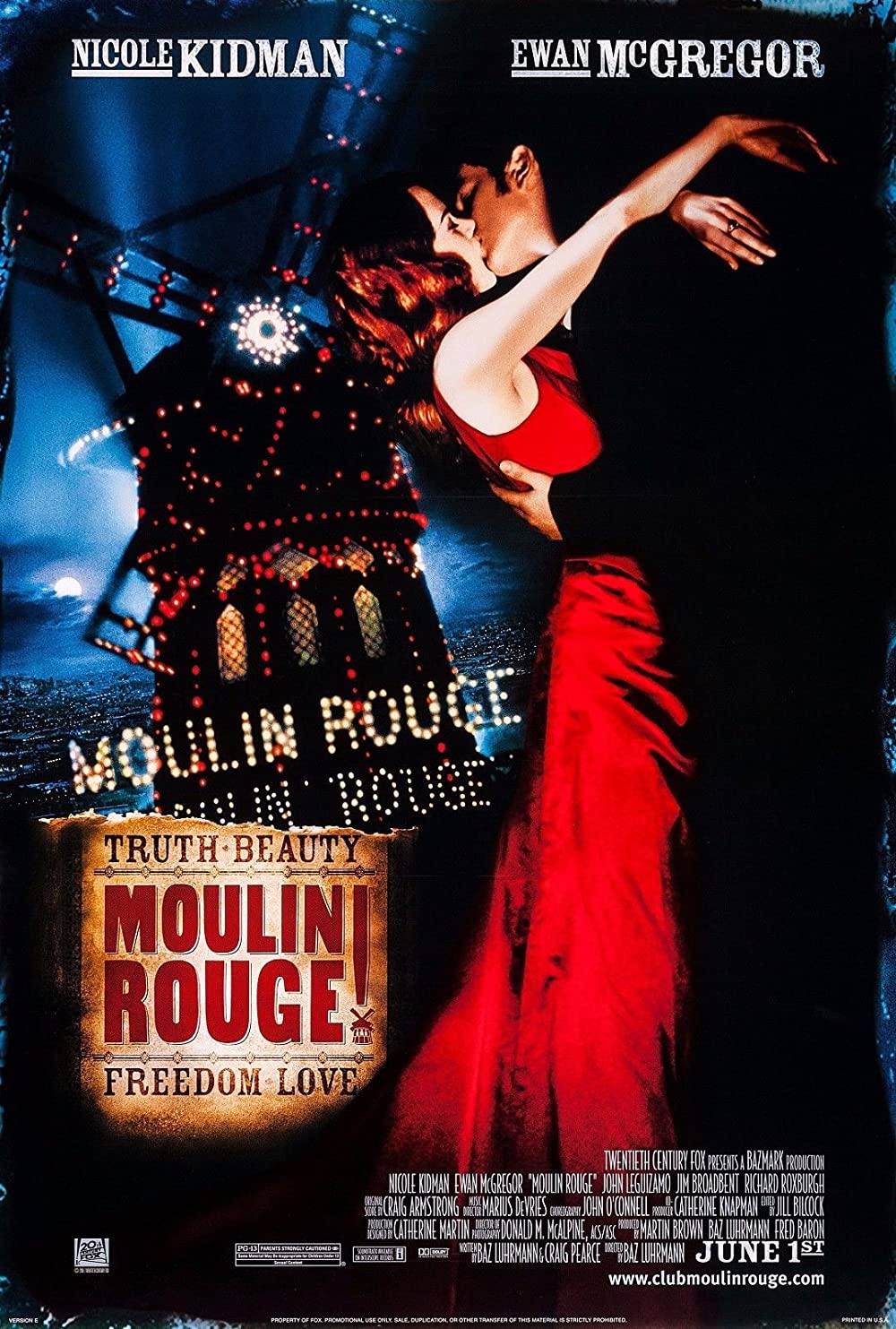
The beauty, flash, energy and movement of "Moulin Rouge" is astounding. It is not just a film, it is a kinetic, visual barrage of richly colored images and upbeat music that thrill and dazzle the mind and enrich the heart. It is also the most tantalizing love story of the year by far.

Ewan McGregor is Christian, a young writer who holds certain ideals in mind, namely the pursuit of "truth, beauty, and love." As soon as he arrives in Paris, he is thrown into the world of the Moulin Rouge which holds all his ideals and more. The Moulin Rouge shown in this film is less the actual nightclub of 1900 and more like a sinful, panoramic display of decadence gone wild. It is so wild and hyperkinetic that director Baz Luhrmann makes us feel we are inside a demented madhouse where anything can happen - we are at the Moulin Rouge firsthand enjoying the party of our lives.

Before embarking at the Moulin Rouge, Christian is introduced to the dwarf artist Toulouse-Lautrec (John Leguizamo) who lives above Christian's tenement. Lautrec comes crashing through Christian's roof one day and, after some initial patter, discovers he can use Christian's creative mindset for a show called "Spectacular Spectacular." The show could prove fruitful for the Moulin Rouge and for introducing the star dancer Satine (Nicole Kidman) - as well as provide income for Lautrec and his merry band of artists and dancers. In order to get backing, they must persuade the snooty Duke of Worcester (Richard Roxburgh) to finance it. In one startlingly funny scene, the group improvise the entire show to the Duke - a sort of rambunctious version of a Hollywood pitch meeting. The Duke is overwhelmed and yet sold to the idea. There is only one hitch - the Duke must also have Satine as his bed mate and possible wife.

The character of Satine is the one that shines the most in "Moulin Rouge." She is a prostitute and flashy dancer but underneath her exterior lies a deathly ill woman whose heart sings whenever she sees Christian. Christian adores Satine and is inspired by her. Satine is pleased by the attention and loves Christian but she is also aware of her duties, to please the sneering Duke who is after all financing the play. One character in the film even sings the famous phrase, "And the show must go on."

"Moulin Rouge" has an old-fashioned romance that is as old as the Ten Commandments. Writer seeks and receives inspiration from prostitute who has a heart of gold. My, my, what an innovative idea! The difference is in the execution. Ewan McGregor and Nicole Kidman set the night sky sparkling with fireworks thanks to their charisma and credible romantic longing. All it takes is for McGregor to sing "All You Need is Love" against a starry nightscape and you know he sincerely means every word he utters.

Nicole Kidman continues to surprise me in every film she is in. From her cold-hearted murderess in Gus Van Sant's "To Die For" to her heartfelt performance in Stanley Kubrick's "Eyes Wide Shut," Kidman breathes life on screen with her radiance, beauty and intelligence. In many ways, she is as enigmatic as the late Greta Garbo, and her Satine masks her pain as well as her happiness. Kidman is the rare actress who makes you stare at her, as watchable as anyone else right now, and she had me swooning long after the film was over.

The film itself throws all kinds of visual razzle-dazzle pyrotechnics at us, including a constantly roving camera, very fast, precise cutting, lots of dancing, vibrant Technicolor colors, bodies swarming the compositions in such a way as to make Merce Cunningham blush, and so on. "Moulin Rouge" is not just a film, it is the "Natural Born Killers" of musicals - frenzied and high-pitched as hell. Director Luhrmann is practically teasing you, testing your stamina while you watch the fantastic, rapid images unfold on screen. Boredom is not an expected reaction while watching this Moulin Rouge kick. There is even a justifiably trippy montage where the dance group take some absinthe and start to see images of multiple fairies singing and dancing. There is also a bravura tango number using Sting's "Roxanne" that is as marvelous and powerful a production number as any I've seen of late. And, if that is not enough, Madonna's "Like a Virgin" is used ever so briefly to comedic effect.

Despite the cartoonish casting of Richard Roxburgh as the Duke and a few lulls towards the end, "Moulin Rouge" is a fascinating, exhilarating, exhausting and vastly entertaining kaleidoscope of the famous nightclub itself. It's a postmodern pop musical guaranteed to leave you in a giddy high after it is all over.

Friday, May 13, 2022

Big Brother Jesus says Be Happy

 THX 1138 (1971)
An appreciation by Jerry Saravia

George Lucas' stunning debut feature,  the dystopian "THX 1138," is something of a dark horse in his filmmaking career. It is ostensibly an Orwellian nightmare of a movie, a vision close to the heart of Orwell's "1984" yet also bearing a tenuous connection to Aldous Huxley's "Brave New World" in terms of the outlawing of emotions by consuming drugs and the illegal act of sexual activity. Cameras showing fuzzy black-and-white images are omnipresent and there is no respite from the constant surveillance. Pretty much today's world in 2022.

THX 1138 is the code name for one rebellious individual (Robert Duvall) who repairs and builds droids in a closely guarded radioactive facility. Everyone, including women, have shaved heads and seemingly frequent a booth with a Jesus reproduction as its Big Brother where you confess to the most rudimentary issues, like accidentally breaking equipment on the job. All Big Brother Jesus has to say in customary, electronic phrases is "Work hard, increase production, prevent accidents and be happy." 

THX lives with his mate, a female named LUH 3417 (Maggie McOmie), and they both watch holobroadcasts which includes a police droid beating a man repeatedly and some naked woman dancing (which THX masturbates to with the help of a device!) This world where everything looks sterile and is largely pristinely white looks clean yet...unhealthy. Everyone looks like they are staying a hospital in a city where everything is controlled by the flip of a switch. You open your medicine cabinet, immediately a voice asks, "What's wrong?" Pills are to be consumed to eliminate emotion, and we know emotions can't be controlled when you are only human. But who is controlling all this and what is the purpose other than to see how humans act when they are emotionless?

THX does the unthinkable in such a claustrophobic setting - he has sex with LUH and reassures her that they are not being watched (this is after he's not taken his pills). Actually, they are being surveilled by a bunch of older white men in some undisclosed room! Due to the violations, mind experiments are performed on THX and several injections of god knows what. Then he ends up in a vast white room prison ("white limbo") with no walls to be seen. And when the pregnant LUH is "consumed" and her name is used for a test tube fetus, THX loses it and decides it is time to break free of this hellhole.

Not much insight is gleaned from "THX 1138" in terms of who is governing the city and their overall purpose, other than controlling the population and curtailing their emotions through pills. "1984" and "Brave New World" had an entity in control and actually visible bureaucrats who explained their reasoning. In Lucas' world, we get the impression that this is a society operating under the rules of no societal interaction (one amazingly troubling and nerve-frying scene shows people walking fast in what sounds like a rumble with no particular direction or purpose). Most of "THX 1138" is the equivalent of a rumble through some abstract world one cannot comprehend. The immersive sound design by Walter Murch is invasive, frenetic and purposely distracting. The poetry of the images of such an enclosed world by cinematographers David Myers and Albert Kihn really accentuates the closed-off feeling of its sterile interiors and its characters (never seen Robert Duvall so restrained other than perhaps his consiglieri in "The Godfather"). 

I had seen "THX 1138" over 20 years ago and I thought back then that it was a bold, imaginative effort completely different from anything writer-director George Lucas had done since (his short film that this is based on, "Electronic Labyrinth: THX 1138 4EB," is just as compelling). Now I see more clearly that Lucas has captured vividly the dark spirit of Orwell without intentionally capturing the theology or philosophy (the latter only in broad strokes). When THX frees himself above the underground city, he finds solace in a sunlit, barren environment. He's all alone but at least he's free and...so are we.  

Tuesday, May 10, 2022

Adams Family Reunion

 HELLBENDER (2021)
Reviewed by Jerry Saravia

When I see a film about witches mixed with supernatural horror in the mountainous woods of some Northeastern region, I expect a blood-soaked horror movie with split-second images of all sorts of blood-soaked, ghostly manifestations. 1998's  relatively dull "The Eternal" starring Christopher Walken and the late Jason Miller in a story about a Druid witch comes to mind. Of course, there's "The Blair Witch Project" which didn't show a witch at all. "Hellbender" has plenty of blood-soaked imagery and blood pouring out of mouths and pierced fingers. If that was all there was to the film, I wouldn't recommend it yet its human story of a mother and her daughter living in seclusion in the mountains gives it unexpected humanity. And because of that, the horror really gives you a jolt.

The frail, pale-looking Zelda Adams plays Izzy, the home-schooled daughter of her mother (Toby Poser) who looks like those women in Santa Fe, New Mexico who let their gray hairs show just to be natural. Both mother and daughter are vegetarians and they eat huckleberries and twigs and assorted food items they find on their nature walks. They also have their own kick-ass punk band called "Hellbender" with Izzy on drums though nobody in this remote area has been privy to hearing them play. Nothing too abnormal here until we discover that Izzy is not allowed near other people because she is "sick." Truth is Mother is a protective 147-year-old witch and her daughter Izzy might end up being far more powerful than her mom. Izzy does not know she is a witch and somehow, when she ventures off the beaten path to meet some new kids her age and is pushed into consuming a tequila shot with an earthworm in it, the earth will start to shake and people might just die.

"Hellbender" has probably too many of those blood-soaked montages with split-second cuts but that would be its only real fault. I was quite happily entranced by "Hellbender" and the performances by Zelda Adams and Toby Poser really form the strong, familial bond between mother and daughter that may split apart. Only this is clearly no regular family drama with a wicked past shown in the powerful opening that includes a hanging. You know something is afoot when mother and daughter frolic in the snow and spit a copious amount of blood in each other's faces! And Izzy's "Happy Place" is quite mind-blowing to say the least and could give you the heebie jeebies for days.

"Hellbender" is a family affair with Zelda, Toby and John Adams (Zelda's dad and Toby's husband who has a cameo) serving as the unique writers-directors team and I'd love to see them tackle another horror piece with a family drama-of-sorts serving as its centerpiece. The most impressive and haunting performance is by Zelda, the kind of innocent looking girl you might not want to run into in the woods (think of the twins in "The Shining" and you might get an idea of how haunting and piercing a presence she is). Though Mother's past history could've used some elaboration, I overall enjoyed "Hellbender" as a captivating new horror piece that should enthrall fans of the genre, and those who love witches (real witches might get offended but, oh well). Still, there are some icky moments that will make you want to turn away. 

Monday, May 9, 2022

Treasure of Sierra Madre in a frozen hell

A SIMPLE PLAN (1998)
Reviewed By Jerry Saravia
Original review from 1998

Once in a blue moon, a film will come along and will grab you by the throat and never let go - it will also make you identify with actions committed by human behavior under certain circumstances. "A Simple Plan" is that kind of film - a rip-snorting, understated morality tale told with finesse and acute observation by a director who's not known for restraint, Sam Raimi ("Darkman," "The Evil Dead").

Bill Paxton stars as Hank Mitchell, an accountant for a small feed store in the frozen tundra of Minnesota. Only this town is not populated by the stereotypical denizens of "Fargo" - these are ordinary people about to be overcome by extraordinary circumstances. Hank is an average, righteous Joe,
living a complacent, innocent existence with his wife, Sarah (Bridget Fonda). Hank's fate lies in the woods when he's accompanied by his inarticulate brother, Jacob (Billy Bob Thornton), and his alcoholic friend, Lou (Brent Briscoe). The threesome inadvertently discover a small plane lodged in the snow, and there appears a miracle in the form of a duffel bag: millions of dollars in cash. Naturally, the three men are at odds of what to do with the money - Hank decides he'll keep it since he's an accountant and can manage it. The truth is that neither one knows how to deal with such a sticky situation. Hank tells the boys to keep their secret quiet while he does just the opposite - he tells his gleamy, smiling wife when he throws the cash on the table. Lou is no better when he spills the beans to his shouting wife. The only one who seems capable of maintaining secrecy is Jacob because he has no one to turn to
anyway, except his brother.

"A Simple Plan" shows how men and women act when money enters their path, and how their behavior changes drastically. This is not fresh cinematic territory - it's "Treasure of Sierra Madre" in a frozen hell - but what's new is how compellingly the story is told. Hank appears to be the hero of the story but
slowly he's consumed by random acts of violence, and we see that the money means more to him than anybody else. Jacob also shows that he's not a complete idiot, and we're never sure what his true agenda is outside of wanting to stay in an old, decrepit house where their father used to live. Lou is a drunk who teases Hank's manhood, and all he wants is some money to pay for late bills. Only Hank's wife remains the solely sensible one of the lot - she makes the decisions and tells Hank what course he (and the story) should take, and it always, ironically, results in calamity.

"A Simple Plan" is adapted from a 1993 novel by Scott B. Smith, who penned the script as well, but this story does not unfold under expected pretenses, namely countless twists and turns. Actually, the movie is not quite noir - you might call it a bleak drama that transcends noirish expectations with its full-blown character portrayals. There are still no heroes, but that's besides the point - these people are undone by the money that slowly reveals layers in their personalities. Amazingly, the money becomes less and less important to them as the film rolls along to a horrific finale in the woods, unveiled with
unexpected, sudden shocks and a twist of fate unheard of in the movies in quite some time.

Bill Paxton is sheer perfection as Hank, flawlessly wavering between nervousness and anxiety. Is he as righteous as he thinks he is, or does he possess a creepily violent side? Billy Bob Thornton cuts another rich characterization with his dim-witted, stringy-haired, vague Jacob, who holds a grudge against his brother, Hank, and who dreams of going on a date with a simple gal. Bridget Fonda gives one of her finest acting jobs to date as the intelligent Sarah who wants more out of her bland existence. She expresses her rage in a touching, heartfelt speech where she expounds on unaffordable dinners and coupons acquired to save money.

"A Simple Plan" moves along at a controlled pace, involving us at every turn and allowing us to empathize with each of the characters and their motives. The script doesn't satirize nor condescend to the characters. Instead, writer Smith makes them believable and congruent to their actions. This is not just the result of a stirring screenplay and weighty performances, but it is also due to Raimi's simple, unpretentious direction. And the snowy landscape and muffled sounds contribute greatly to the atmosphere - we really feel the literal coldness of the surroundings, as in "Fargo."

"A Simple Plan" may have an unsatisfying ending thematically whereas ambiguity could have resulted in richer, deeper parallels. That is surely a minor carp for a film that makes us realize the severe consequences that come with criminal actions - we must always pay a price no matter how strong we are.